Cloth & materials
Grain de poudre: a refined matte cloth for the tuxedo
Grain de poudre is a tightly woven wool with a very fine grain, a quiet matte finish and deep colour. How it compares with barathea and who it suits.
Mon Amie · 15/10/2026
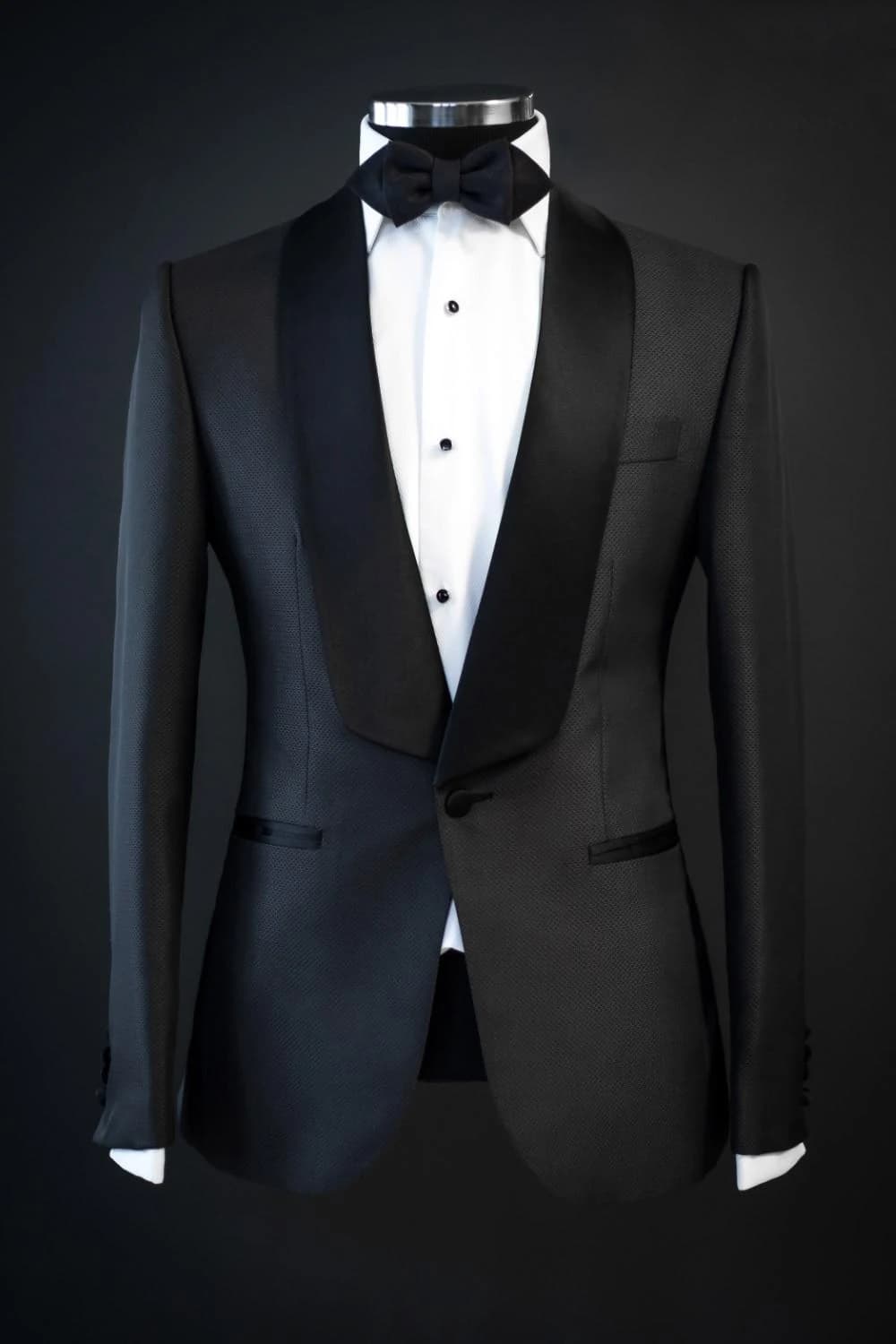
Grain de poudre is a tightly woven wool whose surface is covered in very small, even grains, giving a quiet matte finish and deep colour. The French name means "grain of powder", after the tiny grains of gunpowder the weave resembles. Compared with barathea it is finer, tidier and shows less texture, which suits the man who likes his formalwear subtle.
Small grain, tight weave
The weave forms small round grains set close together across almost the entire face of the cloth. The yarns are twisted firmly and woven densely, so the cloth feels substantial in the hand without having to be heavy.
Only up close do you see the grain structure. From a distance the face looks nearly flat and matte. It is the kind of cloth where an onlooker cannot say what is special about it, but the wearer feels the firmness and the way it stands off the body.
For a sense of how a grain-woven body looks beside glossy facings, look at TUX-062, the Black Satin Shawl Tuxedo. Its description pairs a matte pebble-weave body with a seamless glossy satin shawl lapel, so the two blacks separate clearly. That jacket illustrates the principle of a grain weave; for the exact cloth, ask your consultant when choosing.
Durability and depth of colour
A tight weave resists pilling and bagging at the elbows and knees, and keeps seams crisp through repeated wear. For a tuxedo that comes out a few times a year over many years, that is a practical advantage.
Depth of colour comes from how the surface handles light. Small, even grains absorb and diffuse light softly rather than catching it in patches. Black looks dense, midnight blue looks calm and deep instead of flat. A satin lapel then stands out beside it without the body of the jacket looking dull.
Compared with barathea
The two cloths are close relatives and are often confused. Some typical differences:
| Barathea | Grain de poudre | |
|---|---|---|
| Grain | Larger, more visible | Small, even, finer |
| Handle | Slightly textured, firm | Smoother, more compact |
| Look | Matte, classic, some texture | Quiet, almost flat |
These differences vary by mill, so do not treat the table as a rigid rule. The quickest test is to lay two swatches side by side and turn them under a lamp. Our piece on barathea gives you more to compare against.
Under party lights and in front of a camera
A tuxedo is often worn where there are stage lights, chandeliers or flash photography. A matte surface keeps the body from flaring into white patches, so seams, button rows and pocket lines remain legible instead of sinking into one flat block of black. That is why many tailors favour a grain weave for black jackets: it photographs cleanly.
As for care, a tightly grained cloth should be brushed lightly with a soft brush after wearing, along the direction of the cloth, and hung on a shaped hanger so the moisture can leave. Avoid pressing directly on the face, since heat and pressure can flatten the grain and leave a shiny patch.
Who it suits
- You like a minimal tuxedo where the cloth, not pattern or unusual colour, carries the quality.
- You need a black or midnight jacket that works for weddings, galas and award evenings alike.
- You want a firm shape without a coarse-looking face.
Two points to weigh. Densely woven cloth is generally less airy than open weaves, so if you attend outdoor events in Saigon often, ask for a lighter weight. And because the beauty lies in restraint, the difference is hard to judge from small photographs. Look at the cloth with your own eyes at the showroom.
Book a fitting at Mon Amie
When you choose cloth, a Mon Amie consultant will place a grain-weave swatch beside a strip of satin so you see the real contrast. You can read about the process on the made-to-measure tuxedo page and book a cloth viewing at a showroom to compare in person.