Tuxedo know-how
Anatomy of a Tuxedo Jacket: Every Part Named
Lapel, silk facing, covered button, jetted pocket, vent, lining and canvas: what each part of a tuxedo jacket does and its conventions, shown on TUX-010.
Mon Amie · 17/10/2026
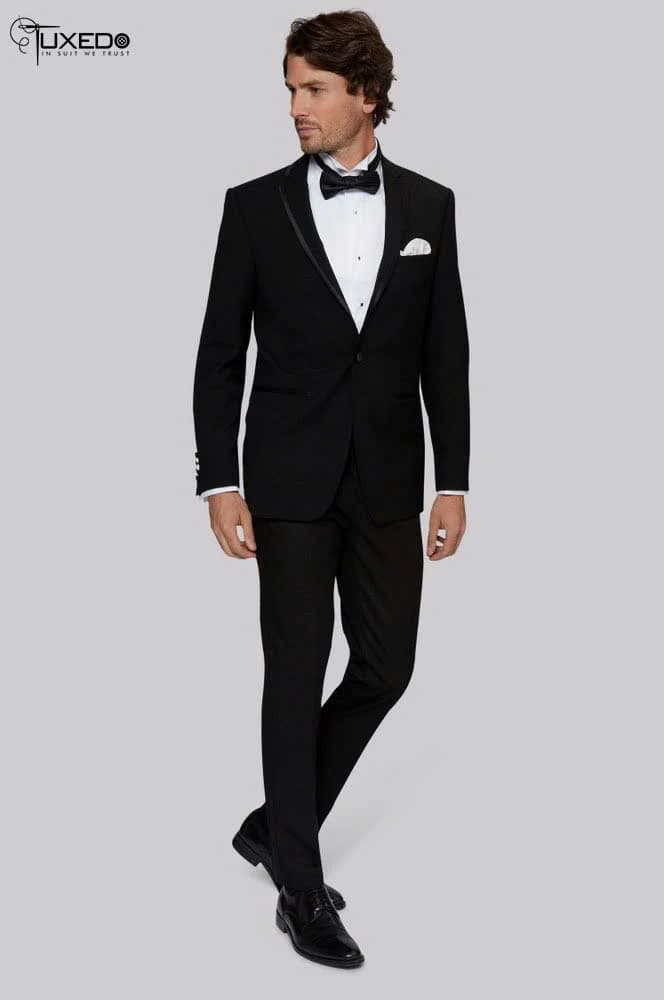
A tuxedo jacket is made of about a dozen parts, and each has either a reason to exist or a convention attached to it. Once you know the names and roles, you can tell a correct tuxedo from a dark suit with a little satin added. This article goes from top to bottom, using the TUX-010 as its example.
The lapel and its facing
The lapel is the part of the front that folds back across the chest. On a tuxedo it is covered with a glossy cloth called the facing, usually satin or grosgrain, while the body of the jacket is wool or a denser cloth with a duller finish. That contrast is the key marker of formalwear.
There are three lapel shapes: the shawl, rounded in one unbroken line; the peak, with points sweeping up toward the shoulder; and the notch, with a notch like a suit. The first two are the tuxedo standard; the notch lapel does appear but is less classic. On why the lapel is faced in silk, see why tuxedo lapels are faced in silk.
The TUX-010 takes a distinct approach: its peak lapel carries only a narrow band of satin along the edge instead of a full facing, giving a fine line of sheen while keeping the cloth's quiet depth.
The button
A tuxedo usually has one button, placed at the natural waist. One button lets the lapel line run lower, opens up more of the shirt front and keeps the jacket slim. The button is often covered in the same cloth as the facing for a seamless look; some suits use black horn. More is in the article on tuxedo jacket buttons.
The pockets
The hip pockets of a tuxedo are jetted: a narrow slit with a thin edge and no flap. The edge is usually of the same cloth as the facing, so the line of sheen on the lapel repeats at the hip. The breast pocket on the left is also jetted, for the pocket square. The TUX-010 has a white square folded in a fan shape here.
Flap pockets and patch pockets belong to ordinary suits or sports jackets and are not part of traditional formalwear.
The body, back and vent
The body of a tuxedo is cut clean and close, fitting the chest and waist. The shoulder is structured only moderately, so as not to show off, because formalwear calls for elegance rather than muscularity.
The traditional jacket has no vent, giving a continuous, clean back. Side vents appear on some modern suits but are not the original standard. The reasoning and how far it is tolerated are discussed in what a tuxedo leaves out.
The sleeve end
The cuff usually carries a row of small buttons set close together. On many higher-grade suits these are working buttons that can be undone; on others they are only decorative. The TUX-010 has small buttons set tightly at the cuff, in this manner. The shirt cuff should show roughly a centimetre or two when your arms hang, so the cufflinks can be seen.
Inside: lining and canvas
Two things inside the jacket go unnoticed by the wearer but matter greatly to the tailor.
Canvas is the stiffening layer in the chest that holds the shape and gives the lapel its natural roll. A canvassed jacket differs from a fused one in durability and in the way it moulds to the body with wear. The method of construction varies with the price line and cloth, so ask your consultant when choosing.
Lining is the smooth cloth inside, usually slippery so that the jacket goes on and off easily. The lining colour is where you can show personality without breaking any outer convention.
What separates a tuxedo jacket from a suit jacket
| Detail | Tuxedo | Ordinary suit |
|---|---|---|
| Lapel | Satin or grosgrain facing; shawl or peak | Same cloth as the body; usually notch |
| Button | Usually one, covered | Two or three, same cloth |
| Hip pockets | Jetted, no flap | Flapped or jetted |
| Vent | Usually none | Centre or side vents |
| Matching trousers | Satin stripe down the leg | Plain |
You can see this comparison in more depth in how a tuxedo differs from a suit.
See a real one in your hands
Reading the names of the parts is only the first step; touching the facing, feeling the covered button and checking the pocket edge is where the differences show. If you would like to see all of these details on your own frame, read about made-to-measure tuxedos and book a fitting at Mon Amie.