Tuxedo know-how
The Duke of Windsor and Midnight Blue Evening Wear
Did the Duke of Windsor bring midnight blue into men's evening dress? What is documented, why the colour reads well under lights, and his other influences.
Mon Amie · 25/10/2026
The Duke of Windsor is often credited with helping to make midnight blue evening wear fashionable, though it is more accurate to say he popularised it than invented it. He was Edward, Prince of Wales, through the 1920s and early 1930s, became Edward VIII in early 1936, abdicated at the end of that year, and was known as the Duke of Windsor from then on. What is certain is that the press and the tailoring trade followed what he wore closely, so a small preference of his spread quickly.
What is documented, and what is anecdote
It is widely recorded that he was among the most influential men's dressers between the wars, and that midnight blue and several relaxed evening details are associated with his name. By contrast, the story that he "invented" each of these is usually anecdote; no source confirms that he alone was behind any of them.
Read the neat stories around this figure with a little caution. The useful part is the direction he favoured: evening clothes that are clean, soft and comfortable while still respecting convention.
Why midnight blue works under lights
The reason tailors repeat is light. Under the warm electric light of a ballroom, and especially in the black and white photographs of the time, black cloth can look flat, sometimes drifting towards grey or a faint green. Midnight blue cloth looks just as deep, yet keeps its play of light and shade across the folds, the shoulder line and the lapels, so the suit has more dimension.
That still holds today. In a golden-lit room, midnight blue is almost indistinguishable from black. In daylight or under a strong flash it shows itself as blue. So view swatches under both kinds of light; for the full comparison see black or midnight blue tuxedo.
Other contributions commonly linked to him
Midnight blue was not the only thing. The following are commonly associated with him and are widely mentioned in histories of menswear:
- The soft dress shirt: in place of the stiff starched front and detachable collar, he preferred a softer evening shirt, easier to sit and dance in. Pleated and soft piqué fronts followed the same path.
- The shawl lapel: the rolled, uninterrupted collar line is softer than a peak lapel, and became well liked on evening jackets in this period.
- The double-breasted jacket: the double-breasted dinner jacket became widespread in the 1930s, partly thanks to style leaders such as him.
- Lighter evening wear for warm weather: he belonged to the generation that accepted lighter-coloured, lighter-weight evening jackets in hot climates.
In each case, read it as "he helped popularise", not "he devised".
Taking the spirit into your own suit
What is worth borrowing is not each detail but the thinking: correct evening dress that is comfortable to wear.
- Colour: if you already own a black suit, midnight blue is a sensible second one in terms of etiquette. Choose a very dark, near-black tone, not a bright navy.
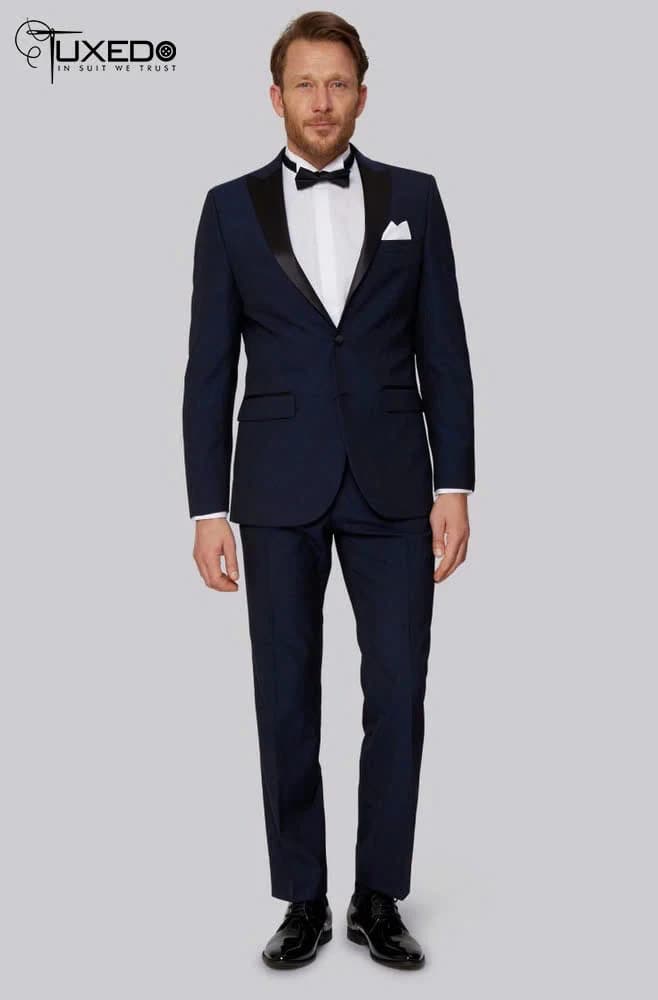
- Lapel: a satin shawl lapel on midnight blue reads soft and classic. See the Midnight Navy One-Button Tuxedo (TUX-018): deep navy-midnight, black satin peak lapels, one button at the waist.
- Cut: natural shoulder, a close but not tight body. Trousers in the same cloth with a satin braid down the leg.
- Shirt and tie: white shirt with a soft pleated front, and a hand-tied bow tie rather than a pre-tied one.
You can browse every cloth in this family in the Midnight Blue & Navy collection.
A note from the Mon Amie workroom
If you want a true midnight blue suit, come to a showroom and look at the cloth under warm and white light, next to black. A consultant will advise on lapels, trousers and shirt for your build; making time is confirmed at measuring, so book ahead of your event. Book a fitting at a showroom.