Tuxedo know-how
What a Tuxedo Leaves Out: Vents, Cuffs and Belt Loops
Why a traditional tuxedo has no vent, no trouser cuffs, no belt loops and no flap pockets, and how far modern variations are accepted for black tie.
Mon Amie · 21/10/2026

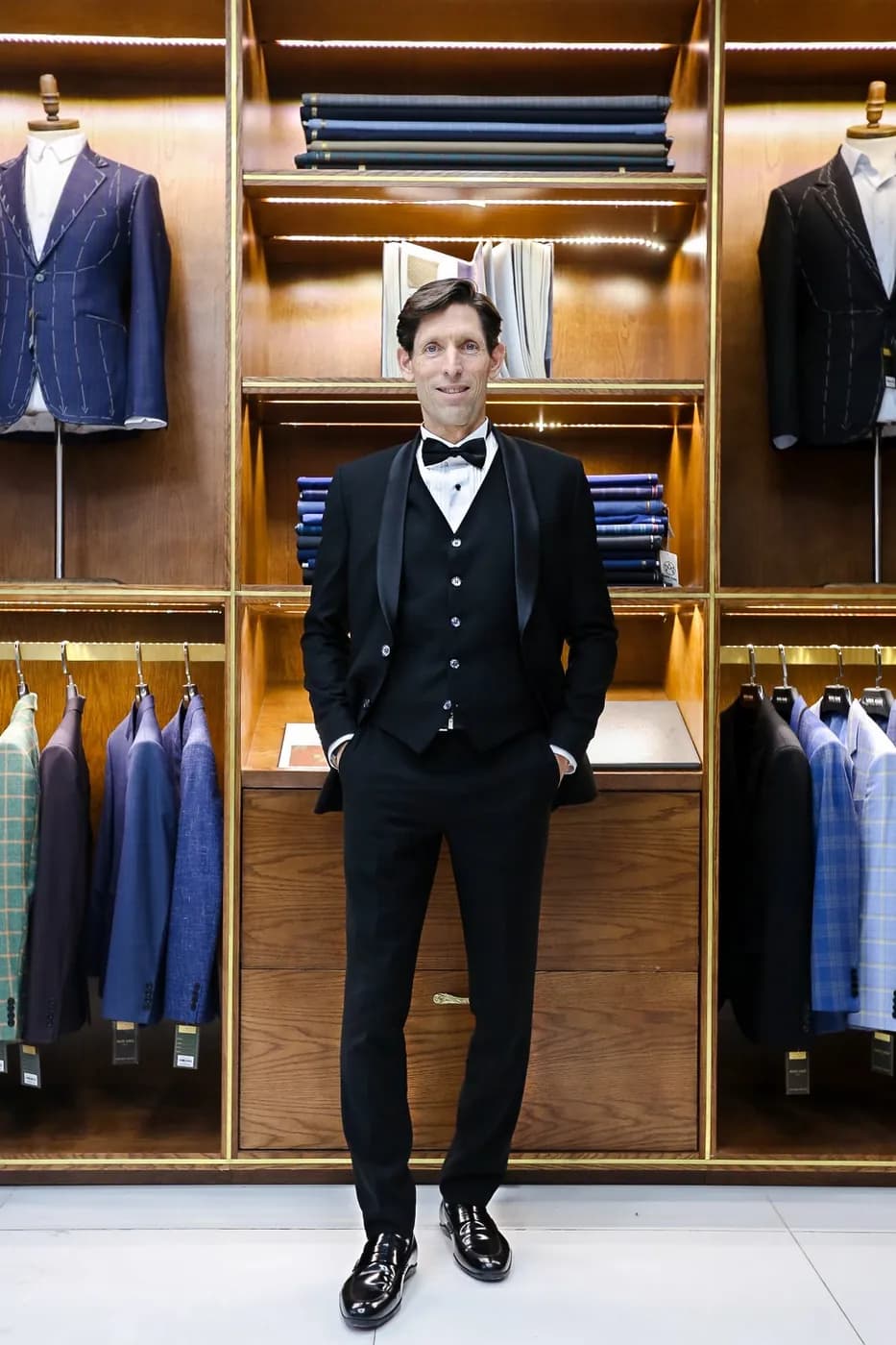
A correct tuxedo is distinguished by what it has, but also by what it leaves out: no vent in the jacket, no cuffs on the trousers, no belt loops on the waistband, no flaps on the pockets. Each missing detail is a convention with a reason, and understanding the reason tells you when you may be flexible and when to hold to the rule.
Why the traditional jacket has no vent
The vent was born in riding and hunting coats, so the skirt would not bunch when sitting on a horse. It belongs to daywear and sportswear. Evening dress descends from the tailcoat and the dinner coat, where the cut at the back is continuous, clean and unbroken.
No vent makes a flat, seamless back that suits the compactness of black tie. The practical drawback is that when you put a hand in a trouser pocket or sit down, the skirt may flare slightly. A tailor compensates by controlling the jacket length and the fit over the seat when drafting the pattern.
Why the trousers have no cuffs
The turn-up, or cuff, began as a way of rolling the hem for muddy roads and later became a decorative style. It is a daywear detail. Formal trousers go with patent shoes and carry a ceremonial air, so the hem is left plain, falling straight from the leg to the instep. A plain hem also keeps the satin braid down the leg running clean to the end.
The length of the trouser matters more than any other detail here: the hem should touch the instep lightly with a single small break, not pile up on the shoe. For the braid down the leg, see why tuxedo trousers have a silk side stripe.
Why the waistband has no belt loops
The traditional tuxedo trouser sits high at the natural waist and has no loops for a belt. Instead it uses braces fastened to buttons inside the waistband, or side adjusters on each side. A wide belt is regarded as spoiling the line, since the waist of formalwear is usually covered by a waistcoat or cummerbund and there is no room for a large metal buckle.
When you wear a cummerbund or a low-cut waistcoat, nobody sees the waistband, so a belt is even less necessary. These two options are discussed in three-piece tuxedo: waistcoat or cummerbund.
Flap pockets and patch pockets are not formalwear
The flap pocket began on day coats and sports jackets, where the flap keeps dust and rain out. The patch pocket is more casual still. Formalwear uses the jetted pocket: a narrow slit with a thin edge, often in the same cloth as the facing, so the line of sheen from the lapel repeats at the hip.
On a suit like the TUX-010, the breast pocket holding a fan-folded white square shows this clean approach. If you need to carry something, the inside pocket is more suitable. In formalwear, avoid filling the hip pockets because the jacket will bulge.
How far modern variations are accepted
Convention is not strict law, and the allowance depends on the dress code:
- Side vents: found on many modern suits and accepted at softer black tie occasions. A centre vent in the style of a day suit is less suitable.
- Discreet belt loops: some suits are made with small hidden loops for a slim belt. Under a cummerbund it does no harm, but it is still a step away from the standard.
- Cuffs on the trousers: there is almost no room for turn-ups at black tie.
- Flap pockets: usually seen only on "suit-style tuxedos" for semi-formal occasions.
For an event that says black tie in earnest, staying near the standard is the safe way. For an evening with room for personality, such as creative black tie, you have more choices. For the levels of dress code, see the dress code page.
On vented or ventless
This is one of the questions you meet most when choosing a cut, and there are arguments on both sides. You can read about it separately in vented or ventless tuxedo. The overall standard sits in the tuxedo standard.
A note from the Mon Amie tailors
Tell the consultant the occasion and the dress code on your invitation, and they will advise how closely to keep the standard. If you want a version relaxed slightly for your build or habits, such as side vents to sit comfortably, the tailor will also say plainly what that trades away. See made-to-measure tuxedos and book a fitting at a showroom to discuss it in person.