Tuxedo know-how
Why Tuxedo Trousers Have a Silk Side Stripe
The trouser stripe comes from military uniforms and evening trousers. One stripe for black tie, two for white tie, and why it lengthens the leg.
Mon Amie · 20/10/2026
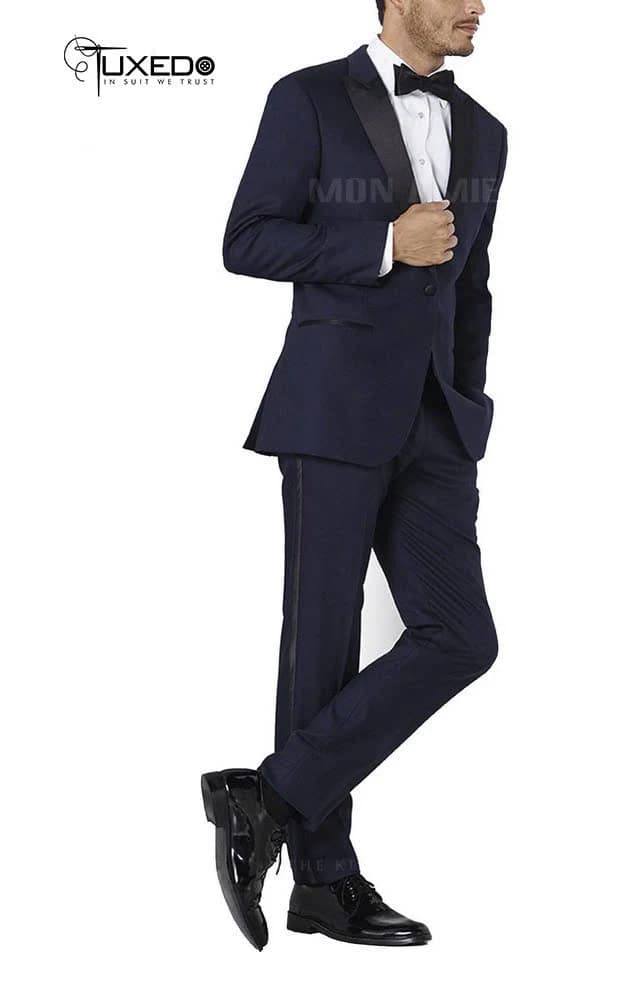
The satin stripe down the outside of a tuxedo trouser is not there only to look good. It is a legacy of the braid on military uniforms and on nineteenth-century evening trousers, a detail that tells onlookers you are wearing true formalwear. Its beauty came afterward: a vertical line makes the legs look longer and slimmer.
Origins: uniforms and evening trousers
A braid down the side of the trouser leg existed on European military uniforms, where it marked rank or branch. As civilian evening dress took on the manner of ceremonial wear, the trousers worn with the tailcoat were also given a silk braid. This is the explanation usually given, although the historical record of each step is incomplete, so it should not be stated too precisely.
When the short evening jacket appeared and gradually became the tuxedo, the trousers kept the stripe, just as the jacket kept its silk-faced lapels (see why tuxedo lapels are faced in silk). The two details have travelled together ever since.
One stripe for black tie, two for white tie
The traditional convention distinguishes them like this.
| Dress code | Trousers | Jacket |
|---|---|---|
| Black tie (tuxedo) | A single braid, moderate width | Short jacket, silk-faced lapels |
| White tie (tailcoat) | Two parallel braids, or one wide stripe | Tailcoat |
The braid on tuxedo trousers is usually around two to three centimetres wide, clear but not overpowering. With white tie the trousers carry two braids or a wider one, worn with a tailcoat. To tell the two levels apart in detail, see tuxedo versus the white tie tailcoat.
The stripe must match the lapel facing
The key principle: the trouser braid must be of the same cloth as the facing. If the lapel is satin, the stripe is satin; if the lapel is grosgrain, the stripe should be grosgrain too. Matching cloth means matching shine and the same way of catching light, so when you stand upright the two details join into one rhythm from chest to foot.
If the two differ, say a glossy lapel and a dull stripe, the outfit looks assembled from two suits. It is a small fault, but a person who knows formalwear will see it at once. The TUX-034 is an easy example to picture: a navy tuxedo with black satin peak lapels, trousers with a satin stripe down the leg, and hip pocket openings trimmed in satin of the same kind to continue the lapel's sheen.
Why the stripe makes the leg look longer
The eye follows a straight line. A glossy band running from the waistband to the ankle pulls the gaze vertically, so the legs look longer and neater than in plain trousers. The braid also divides the outer face of the leg into two zones, which makes the trouser look slimmer.
The effect is stronger when the trouser is straight, well fitted and hemmed to touch the shoe at the right length. If the trouser is too wide or too long, the stripe breaks into folds and loses its purpose. That is why a tailor checks the braid carefully at the fitting.
A few notes on choosing striped trousers
- Only a tuxedo or other formalwear takes a braided trouser. Wearing one with an ordinary suit jacket looks out of tune.
- The waistband should sit at the natural waist so the stripe runs unbroken from the waistcoat or cummerbund downward.
- Formal trousers have no belt loops and no cuffs, which keeps the stripe clean (see what a tuxedo leaves out).
- A tuxedo trouser differs from an ordinary trouser in several ways beyond the braid; the comparison is in tuxedo trousers versus dress trousers.
Ask your tailor about the braid
Wide or narrow, satin or grosgrain, perfectly straight or following the line of the leg slightly: small choices, but they decide the final look of the outfit. If you are preparing for a black tie occasion, book a visit to a Mon Amie showroom and a consultant will show the braid on real cloth and measure the trouser to your leg.