Tuxedo know-how
Black Tie Through the Decades: 1920s to Today
How black tie has changed since the 1920s: midnight blue and the shawl lapel, postwar standardisation, 1970s ruffles and colour, and today's slimmer cut.
Mon Amie · 24/10/2026
Black tie has never stood still. From the 1920s to now it has moved from a short jacket still finding its place beside the tailcoat, through a period of strict standardisation, then a rebellion of ruffled shirts and unusual colours, and finally back to a slim, pared-down cut. This article walks through each stage using fairly secure features, and says where something is only a general trend rather than a rule.
The 1920s and 1930s: foundations of modern black tie
After the First World War the short evening jacket (the dinner jacket) became far more common and gradually took the place of the tailcoat on most evenings, except for the highest ceremonial occasions. This period shaped many things we still see today.
- Midnight blue: the very dark blue is associated with the 1930s. The story often told is that under electric evening light, deep blue looks blacker than true black, but that is a tale rather than a verified fact. What is certain is that the colour entered the formalwear palette in those years. Read more in black or midnight blue tuxedo.
- Shawl lapel: the rounded shawl lapel became a familiar choice beside the peak.
- Soft shirts: a trend appeared for soft-fronted shirts with turndown collars, more relaxed than the stiff-fronted shirts of the previous generation.
- White dinner jacket: an ivory jacket for summer and tropical climates became a habit. The article on the white dinner jacket says more.
The 1950s: postwar and standardisation
After the Second World War, black tie became the standard evening dress for city men in Britain and America, and the way to wear it was cast into a clear set of rules. Etiquette books of the time were quite strict about the black bow tie, the white shirt, patent shoes and the cummerbund.
This is the period that fixed the image of "correct" black tie that many people still carry in their heads: black as the default, satin or grosgrain facing, a braid on the trousers, little room for invention. The cummerbund was common, and rental firms began to serve the mass market.
The 1970s: ruffles and unusual colours
The 1970s broke the mould. Menswear exploded in colour and pattern, and formalwear did not stay outside.
- Ruffled shirt fronts and ruffled cuffs.
- Coloured tuxedos: pale blue, brown, burgundy, coloured velvet.
- Very wide lapels and flared trousers.
- Large bow ties, or coloured ones.
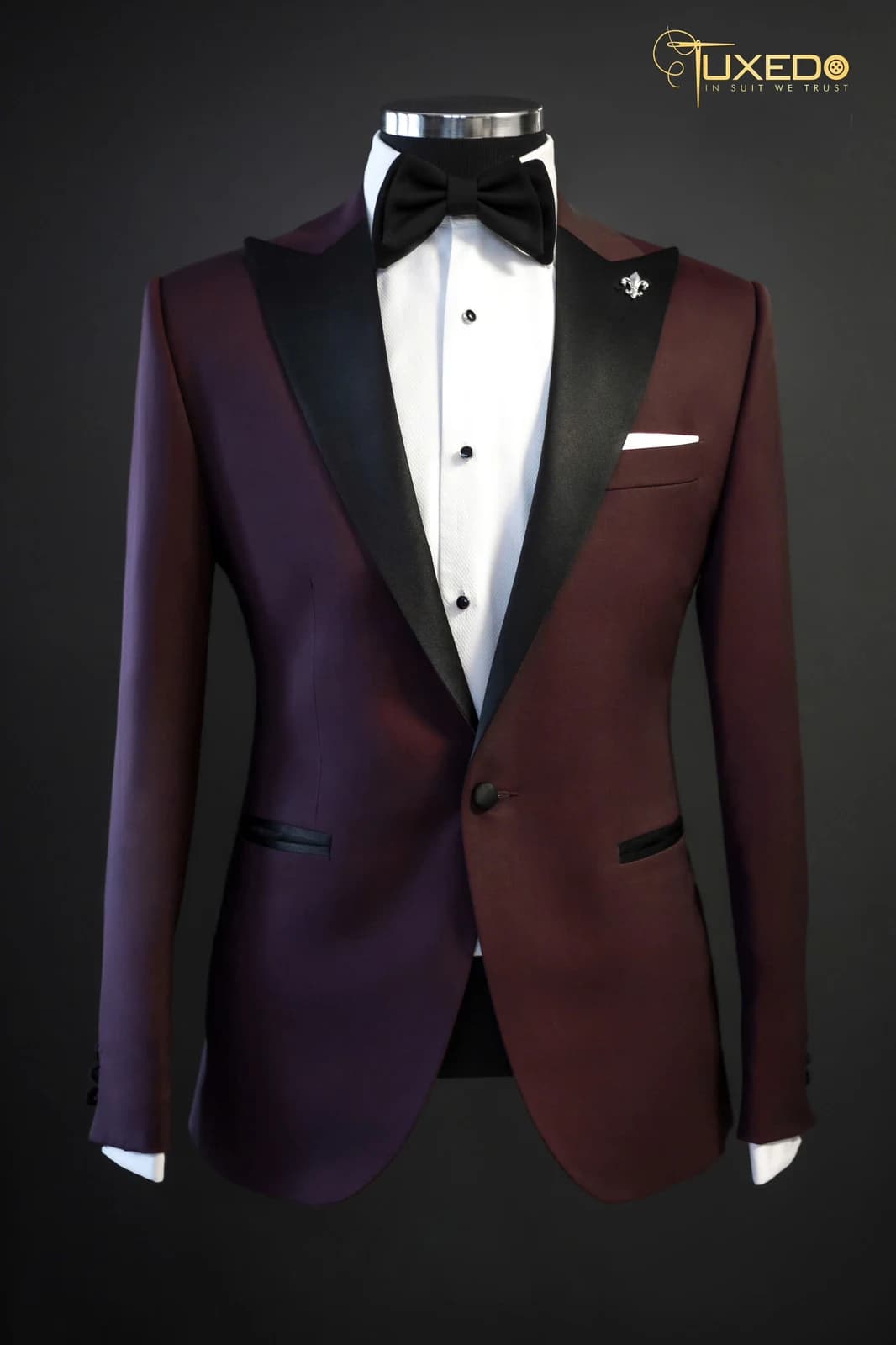
Many details of the era were later judged excessive, and formalwear returned to restraint. But the period opened the idea that black tie could have personality, and today we still see traces in creative black tie and in wine-coloured velvet tuxedos. A modern example is the TUX-020, a burgundy tuxedo with a purple sheen and black satin peak lapels.
The 1980s and 1990s: adjustments
In this stage, padded shoulders and a loose cut stood out in 1980s menswear, then softened in the 1990s with a more minimal style. Black tie still existed but was seldom the centre of attention, and many people saw it as hired dress for special occasions.
Note that this is a general description; each market and each tailor developed along its own path, so it should not be read as a hard milestone.
Today: a slimmer line
The cut now moves toward slimness. Shoulders are more natural, the body fits closely but not tightly, the trouser is straight or lightly tapered, and details are fewer. A lapel with a narrow trim, covered buttons and clean seams are favoured.
At the same time, classic conventions are valued again. Midnight blue, the shawl lapel, the hand-tied bow tie and the velvet jacket appear often at formal occasions. Recent directions are discussed separately in recent tuxedo trends. The common thread is that wearers look back at history to choose what suits them rather than following one mould.
What the wearer can take from it
- The core of black tie, meaning a silk-faced jacket, white shirt, bow tie and patent shoes, has barely changed in more than a century.
- What changes is the cut, the colour, the width of the lapel and the amount of decoration.
- A properly made-to-measure tuxedo does not date, because it rests on conventions that have lasted several decades, while the tailor adjusts the cut to your frame today.
You can revisit the roots of this outfit in the origin of the tuxedo, and browse the tuxedo collection to see present-day designs.
Book a fitting at Mon Amie
Choosing a contemporary cut without hurry is the work of a tailor who sits with you over the cloth and fits it on your frame. If you have a black tie occasion ahead, book a visit to a showroom and a consultant will advise on cut, colour and details to suit your build.