Dress shirts
Fly-front tuxedo shirts: clean and modern
A fly-front shirt hides its buttons behind a strip of cloth for an unbroken chest. How it compares with studs and when it suits a minimalist tuxedo.
Mon Amie · 22/10/2026
A fly-front shirt hides the whole row of buttons behind a folded strip of cloth, so from outside you see an unbroken chest with no studs and no buttonholes. On a tuxedo it is a neat, modern choice: right for the man who likes minimalism and wants the chest left clean so the bow tie and satin lapels do the talking.
Buttons hidden behind a strip of cloth
The construction is easy to picture. On an ordinary shirt the placket is a band of cloth with buttonholes on one side and sewn buttons on the other, the buttons in plain view. On a fly-front shirt the maker adds a second layer of cloth over the top, the row of buttons sits between the two layers, and the outer surface is perfectly flat.
A few characteristics:
- An unbroken chest. Light is not cut by buttons, so the front looks clean and calm.
- Ordinary buttons underneath. Unlike studs, you do not insert anything; you put the shirt on and button it as usual, quickly and with little fuss.
- A slight thickness. The covering layer makes a gentle vertical ridge down the centre, enough to keep the chest upright while staying soft.
This makes a fly front easier to live with than many people expect, especially for men who rarely wear formal dress and dislike fiddling with loose studs.
Suited to minimalist style
A minimalist tuxedo drops what it does not need: no patterned waistcoat, no raised pockets, trim lapels, one colour. A fly-front shirt follows the same principle, removing extra detail so the cut and the cloth speak. You can find more ideas in the minimalist tuxedo.
A fly front is especially good in these situations:
- A black or midnight blue tuxedo with shawl or peak lapels. The flat white chest contrasts cleanly with the satin.
- Modern evening events. Openings, launches, company parties with a relaxed black-tie code.
- A groom who likes a clean line. Close-up photographs show an even chest with no row of buttons dividing it.
- Many hours in the shirt. There are no hard studs pressing into the chest when you sit or embrace someone.
It is fair to say a fly-front shirt is a modern choice, less ceremonial than a piqué or pleated bib. If the invitation says traditional black tie or white tie, a classic bib is the more correct direction.
Compared with studs
The two differ in feel and in handling. This table gives a quick comparison.
| Point | Fly front | Studs |
|---|---|---|
| Look | Unbroken, no visible fastener | A row of loose studs on show |
| Fastening | Ordinary buttons | Fitted before wearing, awkward the first time |
| Feel | Modern and clean | Classic and ceremonial |
| Variation | Limited, changes with the shirt | Swap studs to match the outfit |
| Security | Sewn buttons are firm | A stud can drop out if fitted loosely |
| Suits | Minimalism, modern events | Traditional black tie |
If you enjoy ornament and want the classic detail, studs are the natural choice, with fitting explained in fitting shirt studs. If neatness and fewer things to remember matter more, a fly front is the practical option. Many men keep both: a stud shirt for formal evenings and a fly-front shirt for lighter occasions.
A real model to look at
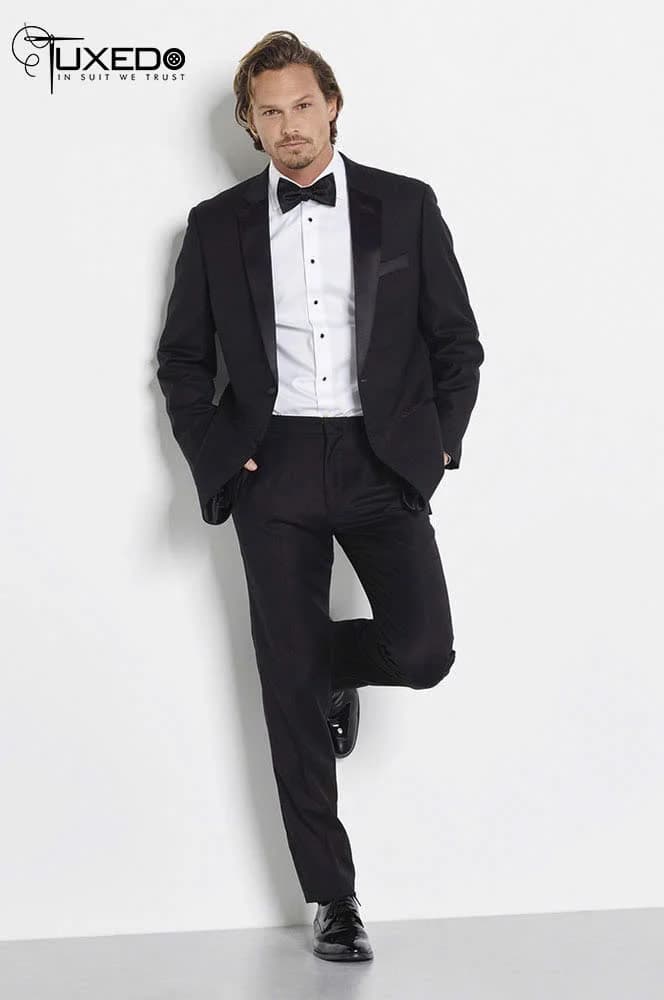
In TUX-037 you can see how a placketed shirt sits within a black tuxedo: a black satin-faced peak lapel, a jacket with soft shoulders, and a white shirt whose front placket carries a row of small black buttons, with a stand collar and a medium black bow tie. To be accurate, on this model the small black buttons remain visible on the placket, so it sits closer to a visible-button placket than to a fully concealed fly front. It still shows the clean, uncluttered spirit of a flat, unpleated shirt front with nothing extra. If you want the buttons fully hidden, tell your specialist when ordering so the shirt is made with a true fly placket.
What to watch when choosing
- The cloth should be smooth and not too thin. A fly front has two layers in the middle of the chest, and a sheer cloth will show a faint shadow of the buttons.
- Placket width in proportion. Too wide and the chest looks heavy, too narrow and it reads as an ordinary shirt.
- The collar still decides the look. Fly front or studs, the collar must frame the bow tie; revisit how tuxedo shirts differ from business shirts for the points that matter.
Advice from the Mon Amie workroom
If you are torn between a fly front and studs, try both on the body with the same tuxedo, because the feel at the chest is quite different from what a photograph suggests. See our made-to-measure tuxedo page or book a showroom fitting.