Dress shirts
Which turndown collar suits a tuxedo
Semi-spread balances a medium bow tie, cutaway frames a large one, and a higher band keeps either upright. Why a button-down collar does not suit a tuxedo.
Mon Amie · 18/10/2026
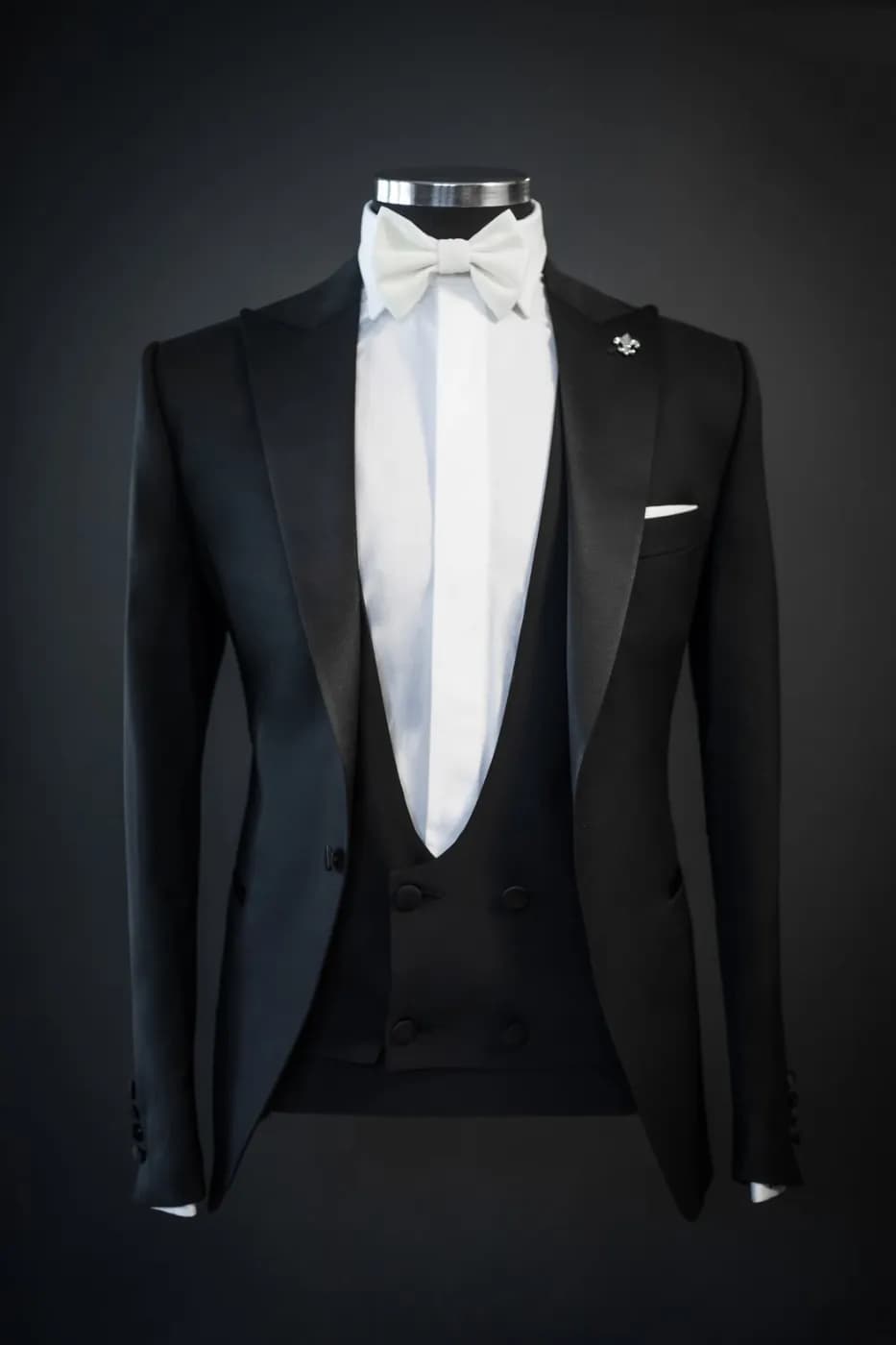
The two turndown collars that suit a tuxedo are the semi-spread and the cutaway: the semi-spread balances a medium bow tie, the cutaway frames a large one. Both need a band high enough for the bow tie to sit upright, and neither should be a button-down collar, which is cut for a necktie and not for a bow.
The article on wing or turndown collars helps you choose between the two families. Once you have settled on a turndown, the next question is which one, and that is what this piece answers.
Semi-spread: balanced with a medium bow tie
A semi-spread has points that open moderately, with enough space between them to show the knot of the bow tie without exposing much cloth on either side. As a whole it is balanced and unshowy.
It works easily because the angle sits between the traditional close collar and the wide spread, so it suits many face shapes and bow sizes. With a medium bow tie, once tied the wings rest neatly in the space between the points, neither crushed nor loose. If you are unsure what to pick, the semi-spread is the safe starting point.
A caution: points that open too little squeeze the bow, and points that open too much make a small bow look lost. Your tailor will adjust the spread to the size of the tie you intend to wear.
Cutaway: for a large bow tie
A cutaway is a wide-spread turndown whose points are cut back, running almost horizontal. The shape leaves room on both sides of the knot, so the wings of a larger bow do not touch the collar points.
The cutaway suits you when:
- You wear a large bow tie or a broad butterfly.
- You have a long face or neck, since the wide spread draws the eye sideways and gives balance.
- You like a modern line with a little presence.
By contrast, a cutaway is less flattering on a very round face or a thick neck, as the wide angle emphasises width. With a small bow, the empty space on either side makes the tie look stranded.
A higher collar band
Whether you choose semi-spread or cutaway, what holds the bow tie in place is the collar band, the upright strip around the neck. On a tuxedo shirt the band is a little higher than on a business shirt, so that the tie sits on the band instead of pressing the skin, and so the points are not dragged upward.
- A band of the right height: the bow lies flat, without tilting.
- A band too low: the tie slides down and leaves a gap between bow and neck.
- A band too high: the neck feels confined and the collar may mark the chin when you look down.
Tie the bow and check the side view in a mirror to see whether it sits level with the line of the neck. This is also where the proportions of bow, lapel and collar must agree; see proportion of lapel, bow tie and shirt collar for that.
Avoid the button-down collar
A button-down collar has its points buttoned to the body of the shirt. It was made for the necktie and for casual shirting; the points are pinned and cannot open to let a bow tie lie. Tie a bow with a button-down and the wings get pushed up, the points bunch around the tie and the whole effect looks like the office.
For black-tie dress the convention is a clean collar with no button fastening. If you own a white button-down, keep it for ordinary suits.
Quick guide
| Situation | Suggested turndown |
|---|---|
| Medium bow tie, want a safe choice | Semi-spread |
| Large bow tie, long face | Cutaway |
| Round face, short neck | Semi-spread with higher band, moderate spread |
| Want a more ceremonial look | Higher band, no button fastening |
| Avoid | Button-down |
Book a fitting at Mon Amie
The surest method is to bring your bow tie and try it against the collar, since only when you see the bow sitting on a real neck do you know the proportions are right. Mon Amie makes shirts to measure and adjusts the spread of the points and the height of the band to your tie. See our made-to-measure tuxedo page or book a showroom fitting.