What the Lapel Buttonhole Is For on a Tuxedo
The lapel buttonhole dates from when coats fastened to the neck and now holds a flower or pin. Working, fake and Milanese holes, and where to place it.
Editor: Mon Amie · Published · about 3 min read

In this article
The lapel buttonhole is the small slit on the left lapel, used today to hold a flower (boutonnière) or a pin. It is also a trace of the time when coats buttoned up to the neck, when this hole did real work. Knowing where it comes from helps explain why such a tiny detail appears on nearly every properly made suit and tuxedo.
Origin: when the coat closed to the neck
By the usual explanation, men's overcoats could once be buttoned right up to the throat against cold and road dust. When needed, the wearer folded the lapels back, but when the coat was fastened high, the lapel buttonhole took the collar button. Later, coats that closed to the neck gave way to open-necked ones, the lapel became a fixed decorative part, and the buttonhole stopped being used for a button.
This is the account most often repeated, though the sources do not agree on exactly when each step happened. What is certain is that the lapel buttonhole has survived through many generations of coats, and today it has a new purpose.
Its job today: a flower or a pin
The buttonhole now has two uses.
A flower (boutonnière). The stem passes through the hole from the front and is held behind the lapel by a small loop sewn on the underside, called a flower loop or keeper. With a tuxedo the flower is traditionally a white or red carnation, or a small sprig that matches the bride's bouquet at a wedding. Grooms use it especially often; our guide to the groom's boutonnière helps you choose.
A pin. The shaft of a lapel pin goes through the hole. Societies and event organisers often use badge pins. Lapel pins on a tuxedo discusses when a pin is appropriate.
One note: choose a flower or a pin, not both on the same lapel, which looks cluttered.

Working, fake and Milanese buttonholes
Not every buttonhole is open.
- A working buttonhole. It is cut through the cloth and bound with firm stitching, so a flower or pin passes through. This is the standard of made-to-measure.
- A fake buttonhole. It is only decorative stitching with no cut. A flower can still be fixed with a metal pin behind the lapel, but without the precision of a real hole. Many ready-made jackets do this to save labour.
- A Milanese buttonhole. A hand-stitched style favoured by Italian tailors, with firm, even raised stitching and a neat end. It is rare and takes more skill, so it appears mostly on higher-end bespoke work.
On a tuxedo the thread colour usually follows the lapel, black on black satin, so the hole blends into the facing and does not call attention to itself.
Correct placement on a satin lapel
The buttonhole sits on the left lapel at about chest height, just below the highest point of the lapel as the jacket is worn. It is about 2 cm long and angled slightly along the roll line of the lapel rather than lying perfectly horizontal.
On a satin lapel, the buttonhole demands more skill, because satin is slippery, frays at the edge and shows stitching. A tailor normally reinforces the underside of the lapel before cutting so the hole holds its shape. On a shawl lapel, which flows without a notch, the hole is still placed at chest height, and the position has to be measured carefully so it does not drift relative to the breast pocket.
If you plan to wear a fresh flower, tell the tailor so the flower loop behind the lapel is set in the right place. TUX-080, with its black satin peak lapel, is a good base for seeing how the buttonhole blends into the facing.
How Mon Amie can help
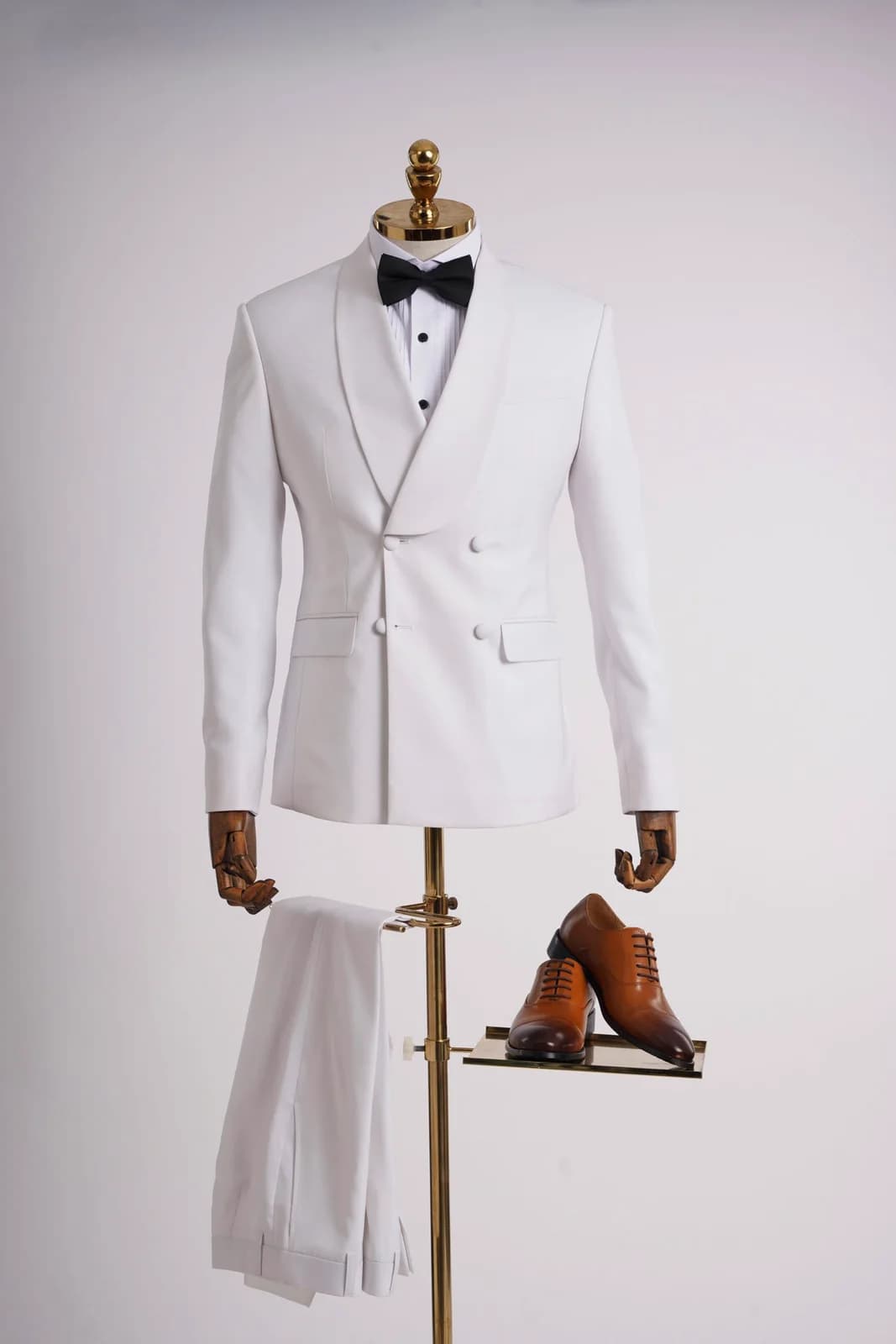
When ordering a made-to-measure tuxedo, the lapel buttonhole is worth asking about because it is rarely mentioned in a quotation. Tell the consultant if you plan to wear a flower or a pin, or if you would like a hand-stitched hole. You can read more about the options on the made-to-measure tuxedo page and book a fitting to discuss it in person.
Published 12/11/2026 · 07:00 · Editor: Mon Amie