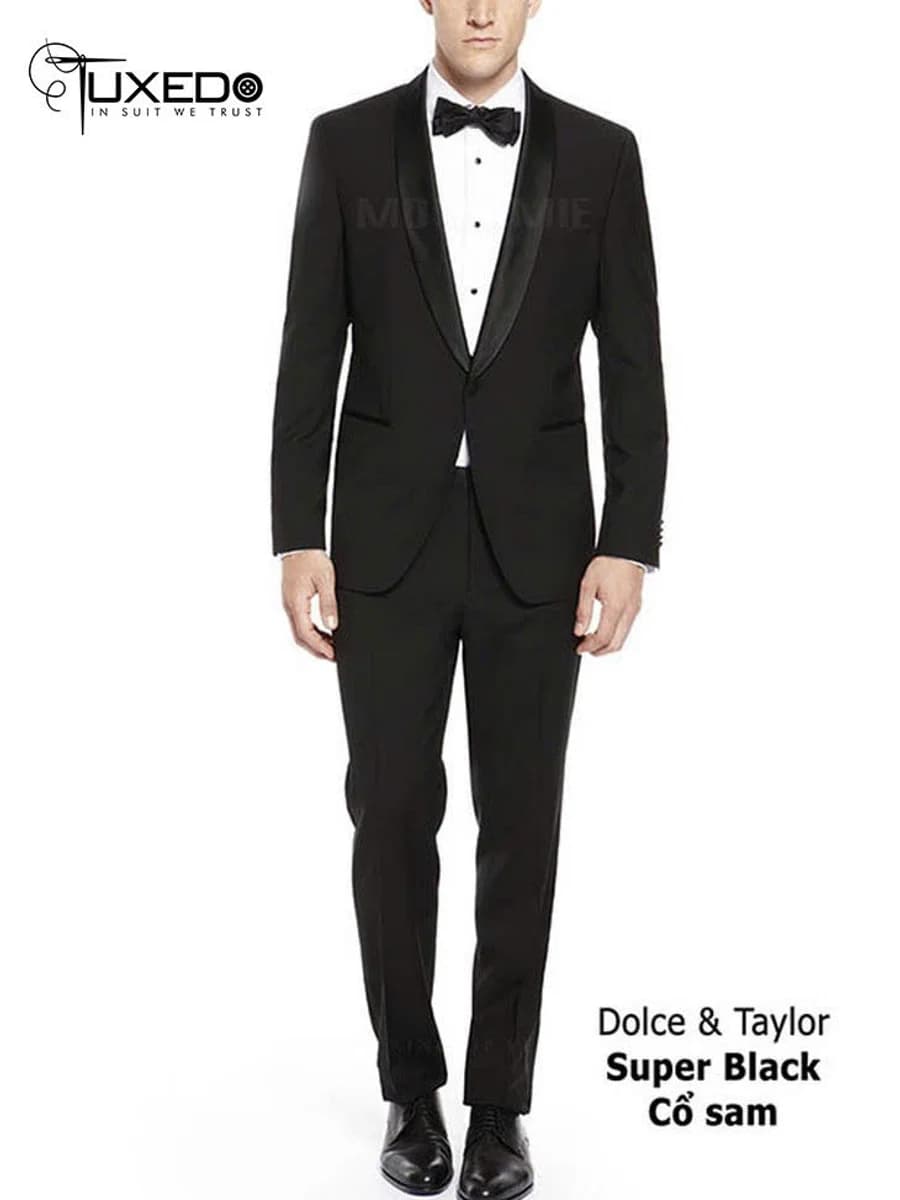
Super black: why some black tuxedos look deeper than others
Super black is black cloth with deeper colour than ordinary black. How yarn, dyeing and weave create the depth, how to spot it by eye, and how to keep it black.
Editor: Mon Amie · Published · about 4 min read
In this article
Two tuxedos can both be called black and look entirely different side by side: one as dark as ink, the other leaning slightly grey or brown under the lights. "Super black" is the trade name for black cloth that is deeper than usual. That depth does not come from a secret. It comes from how the yarn is spun, dyed and woven.
One thing should be said plainly: "super black" is a term used in the cloth and tailoring trade, not an agreed technical standard. Different suppliers use it to different degrees, so what you see when you hold a swatch under light is more trustworthy than the name.
Why some black is deep and some is thin
Deep black is the sum of three factors.
Dyeing. Wool is not pure white but a pale cream, so reaching a truly deep black means the dye must penetrate the core of the fibre and not just sit on the surface. The quality of the dye and control of temperature and time decide this. Under-dyed cloth carries a thin layer of black and shows brown or blue-grey tones in strong light.
Fibre and twist. Fine fibre, spun tight and even, gives a smooth, low-fuzz surface. The smoother the surface, the less white light it scatters, so the eye reads it as darker. A hairy surface scatters more light and makes black look greyer.
Weave and finish. A close, firm weave and a finish that leaves a clean surface add to the sense of depth. A black cloth with slight fuzz often reads as a paler black even when the dye is not very different.
That is why the same black on two swatch cards can feel different: one reads as a block of colour, the other as a cloth with depth.
Ordinary black and deep black compared
| Ordinary black | Deep black (super black) | |
|---|---|---|
| Under indoor light | May lean grey, blue-grey or brown | Stays evenly black, little colour drift |
| In sunlight | Shows its undertone clearly | Stays dense, shifts little |
| Cloth surface | May show fuzz, a dull sheen | Smooth, tidy, looks closed |
| Contrast with satin lapel | Clear if the satin is glossy | Little colour contrast, contrast comes mainly from sheen |
| Showing flaws | Hides dust a little better | Shows lint, dust and creases more |
A practical note: deep black cloth makes flaws more visible, with lint, chalk dust and stray hairs as typical examples. That is the price of a pure black.
For comparison, think of midnight blue: under artificial light a very dark blue can look like black and often photographs with more depth than ordinary black. Midnight blue is one way to gain depth, while super black gains depth within black itself. You can read our comparison of black and midnight blue tuxedos.
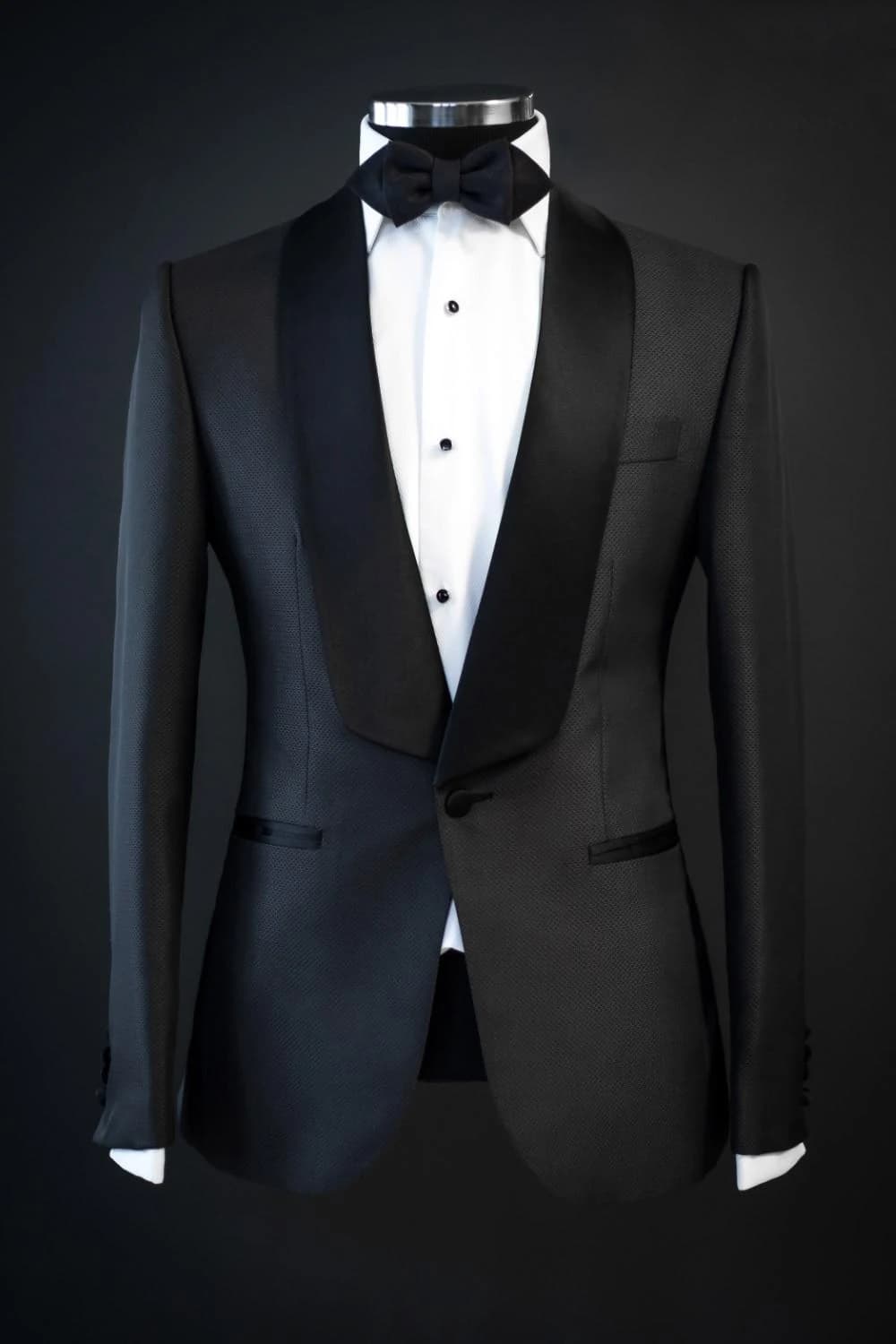
The real jacket: TUX-047
TUX-047 Super Black Shawl Collar Tuxedo is a pure black jacket with a rounded satin shawl collar, a single button and matching straight-leg trousers. On deep black, the rounded line of the shawl collar becomes the focal point: with no colour to create contrast, the sheen of the satin is what draws the lapel.
It belongs to the Classic Black collection, where you can compare other black jackets and see how deep each cloth runs.
How to recognise deep black by eye
Do not rely on the name alone. A few simple checks when you choose:
- Take the swatch to a window or under a lamp and turn it through several angles. Deep black stays even; thin black drifts to grey or brown.
- Place two black swatches side by side. The difference appears at once.
- Look at the surface up close: how much fuzz, and how smooth.
- Ask the consultant about the cloth source and finish, not only whether it is called "super black".
Keeping black cloth black
Even deep black can fade if it is cared for badly, and faded black usually shows as a dull grey or brown cast, especially at elbows, shoulders and lapels.
A few habits help the colour last:
- Limit dry cleaning. Clean only when truly needed, because repeated solvent and heat gradually weaken the dye.
- Steam lightly to freshen instead of pressing hard directly, since high heat can leave a patchy shine on wool.
- Keep the jacket out of sunlight, even through a window, as sun turns black toward brown.
- Brush it with a soft brush along the grain after wearing, so dust does not sit.
- Hang it on a broad-shouldered hanger in a breathable cover, and rest it between wears.
More detail is in our piece on black cloth that keeps its colour.

How Mon Amie can help
The surest way to know whether a black is deep enough is to see the real swatch in showroom lighting and in daylight. You can bring a black jacket you already own to set beside it. Book a fitting at a showroom, and the consultant will confirm the making time when you are measured, depending on the style and the fitting schedule.
Published 22/11/2026 · 16:00 · Editor: Mon Amie