Tailoring, price & rental
Tuxedo fittings: what each one checks
A frame fitting checks shoulders and body; a finishing fitting checks sleeves, hems and waist. How to sit, reach and walk in the jacket, and what to note.
Mon Amie · 15/10/2026
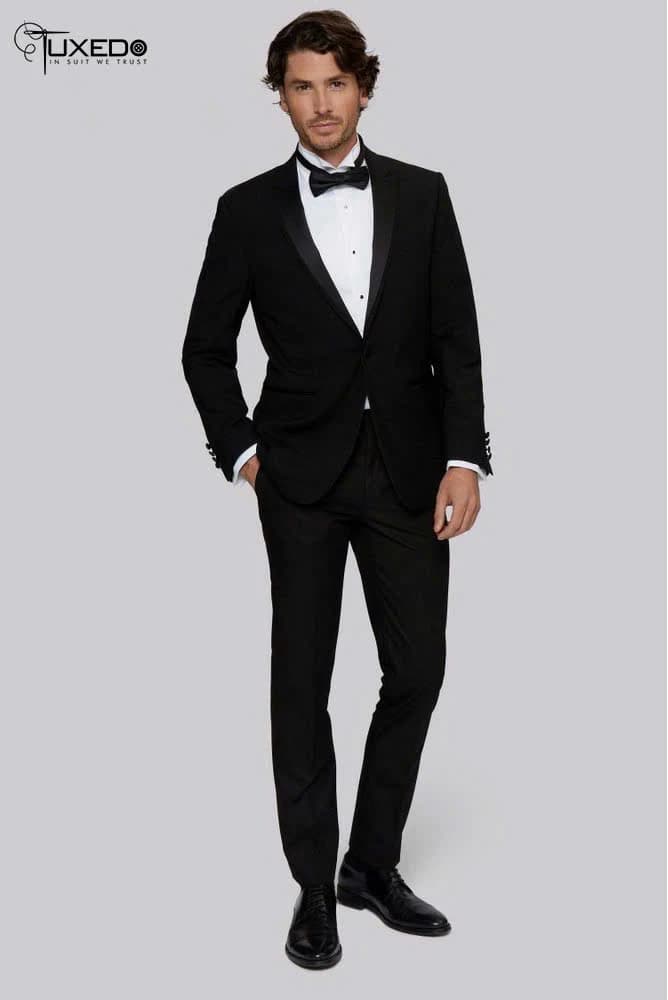
Each tuxedo fitting has its own job. The first, often called the frame or baste fitting, checks that the shoulders and body of the jacket sit correctly on you. The finishing fitting looks at the finer points: sleeve length, trouser hems, waist and waistband. How many fittings you need depends on the style and its complexity, and your consultant will tell you at the measuring session. What matters is knowing what to look for each time you face the mirror.
The frame fitting: shoulders and body
At this stage the jacket is not the finished article. It is a close working version, enough for the tailor to see whether the pattern really matches your frame. The areas that are hard to change late in the process are exactly the ones examined closely here.
Shoulders. The shoulder seam should land on your shoulder point, neither hanging over nor pulling in. The sleeve head should not sit up in a lump, and the sleeve should not drag into a horizontal crease when your arm hangs down.
Collar. The jacket collar should hug the back of your neck and not gap away from the shirt collar when you stand straight. A collar that floats usually points to a balance problem at the shoulders or back.
Chest and body. Buttoned, the jacket should lie flat, with no X-shaped pull around the button and no gaping when your arms are relaxed. On a one-button jacket such as TUX-039, button it, stand easy, and check that the drape runs naturally from shoulder to waist.
Jacket length. It should be long enough to cover the waistband and the top of the seat without swallowing your legs. Try it with the real trousers so the tailor can mark it correctly.
Lapels. They should roll softly and rest against the chest. Satin-faced lapels show every flaw, so this is where the tailor steps back and looks the longest.
The finishing fitting: sleeves, hems, waist
Once the frame is right, the finer parts are completed. This fitting checks:
- Sleeve length. The sleeve usually leaves about one to one and a half centimetres of shirt cuff showing. Wear the shirt you will actually wear, or one with a similar cuff.
- Trouser hem. The hem just touches the top of the shoe and falls cleanly. Bring the real shoes so the tailor can set the length.
- Waist and waistband. The jacket waist shapes you enough to show the line, yet you still breathe and sit comfortably. The trouser waistband sits where you normally wear it and does not slip as you walk.
- Finishing details. The satin braid on the trousers runs straight from waistband to hem, covered buttons sit evenly taut, jetted pockets do not gape, and the lining does not twist.
If your suit includes a waistcoat or a cummerbund, wear it. A cummerbund has to sit between trouser waist and jacket hem, and a waistcoat must not gap at the neck or ride up at the edge when you bend.
Fit it the way you will wear it: sit, reach, walk
Standing still in front of a mirror tells you only part of the story. A tuxedo has to survive the movements of a long evening, so at the fitting do exactly those things:
- Sit down. The jacket should not ride up at the back, the waistband should not dig into your stomach, and the thighs should not pull.
- Raise your arms. To shoulder height, then higher: the body of the jacket should not lift sharply, and the sleeves should not slide far up your wrists.
- Reach forward. As in a handshake, a toast or a group hug for photos. The back should not stretch into horizontal creases.
- Walk a few circuits. The hem should not scuff, the waistband should not twist, and the jacket should not balloon as you move.
- Button and unbutton. Fasten standing, open when seated, to see whether the button is easy to use.
If you plan to dance a lot at the wedding, say so beforehand. The tailor can consider the armhole and the freedom of the sleeve.
Notes so the tailor adjusts the right place
At the end of each fitting the tailor will mark the garment with chalk or pins. You should keep notes of your own too:
- Take photos from the front, side and back, if the showroom agrees, to compare between fittings.
- Note anything that feels odd as soon as you put the jacket on, even if you cannot name it. The tailor will understand from how it feels.
- Ask which points are finished and which are left for the next visit, so you know what to re-check.
- Mention at once if your body has changed: training, gaining or losing weight. Adjusting a tuxedo when your weight changes covers this in more detail.
The last fitting has questions of its own, discussed in the final tuxedo fitting.
Fittings with the tailor at Mon Amie
Fittings are where you say what you feel so the tailor can adjust before you collect. The whole journey is summarised in the bespoke tuxedo process, and you can read about our made-to-measure service. When you need to set a time, book at a showroom or message Zalo 0888.111.118; your consultant will give the specific schedule for each fitting.