Tailoring, price & rental
Signs of a well-made tuxedo: lapels, pockets and seams
A well-made tuxedo shows in a softly rolling lapel, straight even jetted pockets, patterns that match at the seams, and tidy buttonholes, buttons and lining.
Mon Amie · 20/10/2026
A well-made tuxedo shows in small places: a lapel that rolls softly rather than being pressed flat, jetted pockets that are straight and even, cloth patterns that carry across the seams, tidy buttonholes and firm buttons, and a lining that lies smooth. You do not need to be a tailor to see it. Knowing where to look, five minutes in front of a mirror is enough to tell a carefully made jacket from one that was simply finished.
A lapel that rolls softly, not pressed flat
The lapel is where people look first, particularly on a tuxedo, because it is usually faced in satin and catches the light. On a well-made jacket it does not sit flat like a piece of card. It rolls gently from the shoulder down to the button, along a fold line that curves naturally. A shawl lapel is one continuous curve from the collar downward, and on a peak lapel the two points flare evenly to either side.
How to check:
- Stand sideways and look at the lapel from an oblique angle. A good one has a slight swell and hugs the chest without the edge lifting.
- The edge should be crisp and continuous, with no fraying or ripples, and the satin facing should not wrinkle or pull away from what lies beneath.
- The two sides are symmetrical in width and in curve.
The soft roll comes from the construction inside the jacket, not from pressing. For how the stiffening layer between cloth and lining produces it, read canvas versus fused tuxedos. You can also ask your consultant directly how the jacket you are looking at is built.
Jetted pockets, straight and even
A tuxedo uses jetted pockets: the opening is cut as a narrow slit with a welt of the same cloth or satin, and no flap. It is a clean style, and a demanding one, because there is no flap to hide mistakes.
Look for:
- Parallel lines. The openings on both sides run level with the ground, at the same height.
- A closed slit. No gaping, no slack at the ends, and the pocket stays flat after you slip a hand in and out.
- Even welts. The width of the welt above and below the slit is equal, and the ends are square, not slanted.
If the breast pocket carries a pocket square, check that it sits where it should and that the pocket does not bulge underneath.
Patterns that match at the seams
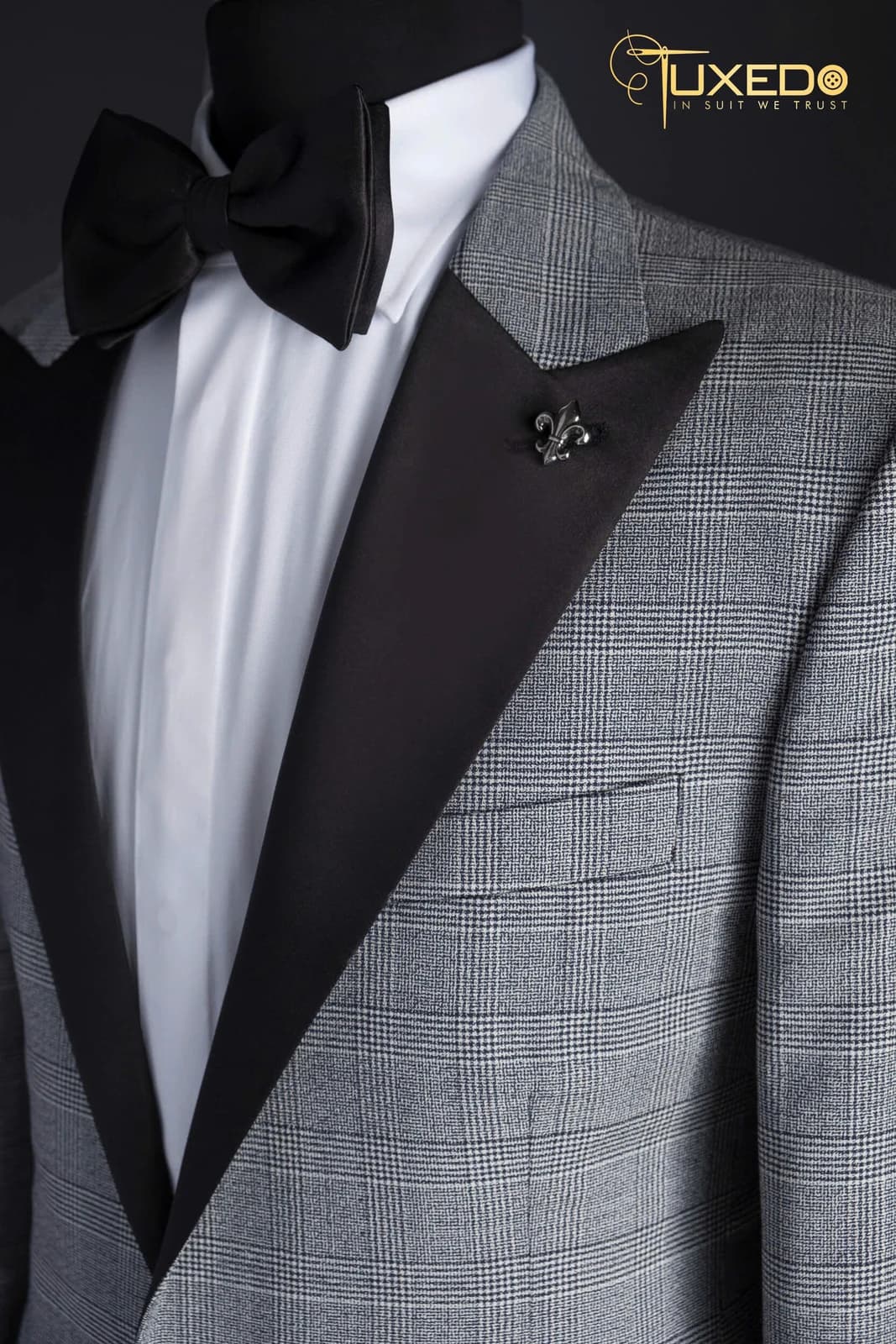
Most tuxedos are plain cloth, but with a woven texture, a tonal stripe or a check, matching is a very clear test. TUX-029, for example, is a silver-grey Prince of Wales check tuxedo with a peak lapel. On a style like that, these points reveal the craft:
- The check or stripe on the front must run unbroken across the button line.
- At the shoulder and side seams the pattern continues rather than breaking off.
- Sleeve and body agree at the sleeve head, with no sudden shift in the direction of the check.
- Both sides are symmetrical: the pattern on the two lapels and two pockets balances.
Matching costs cloth and cutting time, so it is a quick way to separate careful work from economy work. With plain cloth, check that the grain, or the pile direction for velvet, is consistent across pieces, because a mismatch makes two panels look like different shades under light.
Buttonholes, buttons and lining
These final details are often overlooked, yet they give things away on close inspection:
Buttonholes. Stitching around them is even, closed and not frayed. They are wide enough for the button to pass easily without being loose. Working cuff buttonholes (ones that really open) are worth noticing; personalising a bespoke tuxedo covers them.
Buttons. Satin-covered or ordinary, they should be taut, uniform in colour and sewn on firmly, with a shank high enough that the cloth is not pulled tight. The sleeve buttons should match each other.
Lining. Lift the front: the lining should lie flat, without twisting or puckering, with a tidy edge. A soft, breathable lining makes the jacket more comfortable; on lining materials see tuxedo lining.
Stitching. Look at the cuff edge, the jacket hem and the waistband: even stitches, no skipped ones, no stray threads.
Trims such as buttons, thread and interfacing also decide how long a garment lasts; read more in tuxedo trimmings.
A quick mirror check
Holding any tuxedo, ours or anyone else's, you can run through this in order:
- Button up and stand straight: the jacket lies flat, with no pull around the button.
- Look at the lapel from several angles: soft roll, crisp edge.
- Examine both pockets: level, even and closed.
- With patterned cloth: check the match at chest, shoulder and side seam.
- Lift the front: lining flat, buttonholes tidy, buttons firm.
- Sit and raise your arms: no dragging, no twisting.
A jacket that passes all of these was usually made by a craftsman with time and experience, not simply from expensive cloth.
See it in person at Mon Amie
Our Hoang Vy workshop has operated since 1991, with more than 50 tailors who have 10 to 25 years of experience. Come to a showroom and handle a real sample against this list, or read about the bespoke tuxedo service and book a showroom visit so your consultant can show you the construction from the inside.