Can a Vietnamese áo dài replace a tuxedo at black tie
Many international events accept national dress in place of black tie. How to choose an áo dài formal enough for the evening and when to ask the hosts.
Editor: Mon Amie · Published · about 4 min read
In this article
Often, yes. At diplomatic receptions and international events, national dress is generally treated as the equivalent of black tie, and the áo dài is the national dress of Vietnamese men. But "generally" is not "always", and an áo dài worn to a gala has to be chosen far more seriously than one worn at Tết. Here is how to tell the difference, from a workroom that specialises in tuxedos yet is happy to say plainly: on some evenings, the áo dài is the more correct choice.
Why national dress is accepted
International protocol treats national dress as the formal attire of the person who wears it. That is why the invitations of many embassies, chambers of commerce and international conferences carry a line such as "black tie or national dress". A Vietnamese gentleman in an áo dài with a khăn đóng turban is not breaking the dress code; at a table full of tuxedos, a properly done áo dài is often the deliberate standout.
It does not apply to every party. If a private organiser sets "black tie" without mentioning national dress, ask rather than assume. For the ladder of formality, see our piece on what the Black Tie dress code means, and for how these rooms behave, the article on embassy receptions.
Choosing an áo dài formal enough for the evening
An áo dài for an evening function needs more gravity than one for daytime photographs or a family ceremony. Points to watch:
- Colour: deep and quiet, such as ink blue, black, oxblood or dark brown. Avoid pastels and bright festive shades.
- Cloth: brocade, silk with a tone-on-tone weave, or a substantial woven silk with a good drape. Patterns should be small, regular and discreet; avoid large printed flowers.
- Cut: close but comfortable, upright shoulder, clean high collar, panels that do not overpower your height. Modernised áo dài with casual details do not suit formal evenings.
- Khăn đóng: for ceremonial events, the turban completes the outfit. At a relaxed cocktail evening you can leave it out.
- Trousers and shoes: white or matching trousers in a cloth that holds its shape; polished black leather shoes. No sandals, no sneakers.
One rule is shared with the tuxedo: the more a garment shows, the quieter everything else should be.
When to ask the organisers
Send the hosts a line if the invitation says black tie without mentioning national dress, if the event is run by a foreign organisation with mostly international guests, or if you are speaking or standing on stage. The question can be short: "Would an áo dài be acceptable in place of black tie?" Asking is not discourteous; it shows you take the evening seriously.
If the answer is unclear, the tuxedo is the safe route. A well-made tuxedo is never questioned.
Dressing consistently within the same event
Once you choose the áo dài, keep everything consistent with it and do not mix the two systems. Do not put a tuxedo bow tie on an áo dài collar, and do not add a waistcoat or cummerbund. The accessories of an áo dài are the khăn đóng, leather shoes and perhaps a slim watch with a plain dial.
If you attend with a partner, aim for the same system or at least the same level of formality: if she wears an áo dài, you wear one too, and if you wear a tuxedo, an evening gown suits her. An áo dài standing next to a tuxedo is perfectly acceptable as long as both are at evening-dress level. At a wedding, if the groom wears an áo dài, the groomsmen should follow so the photographs stay in balance.
When the tuxedo is still the right answer
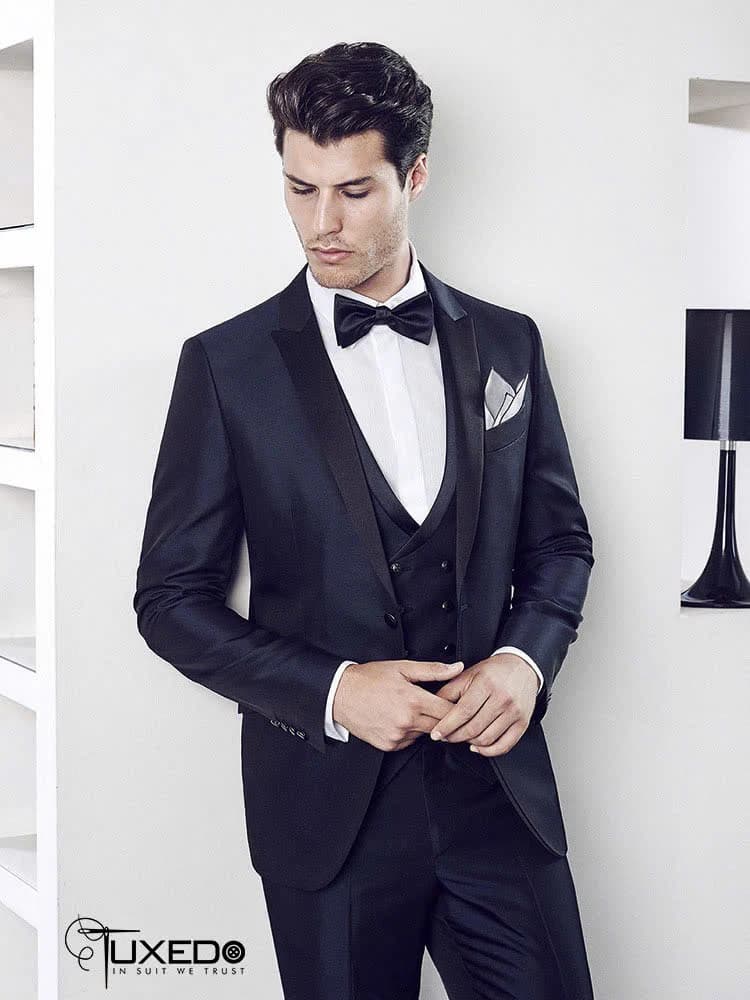
The áo dài does not always replace the tuxedo. Choose the tuxedo when the dress code says black tie and national dress is not mentioned, or when the event follows Western ritual, such as a classical concert or a charity ball. For a man who attends events across cultures, one complete black tuxedo plus one dark áo dài for national-dress occasions is a neat, sufficient wardrobe.
Notes from the Mon Amie workroom
Mon Amie specialises in tuxedos, so what we can do is read the dress code on your invitation with you and decide whether a black tie suit is worth making. Bring the invitation along, or book a showroom visit and a stylist will go through it with you. See also the dress code page and our bespoke tuxedo service.
Published 20/11/2026 · 19:00 · Editor: Mon Amie