By occasion
Performance Tuxedos for Singers and Musicians
A performance tuxedo differs from a party one: reach and turn, stretch cloth, breathable lining, details that catch stage light, durability across many nights.
Mon Amie · 22/10/2026
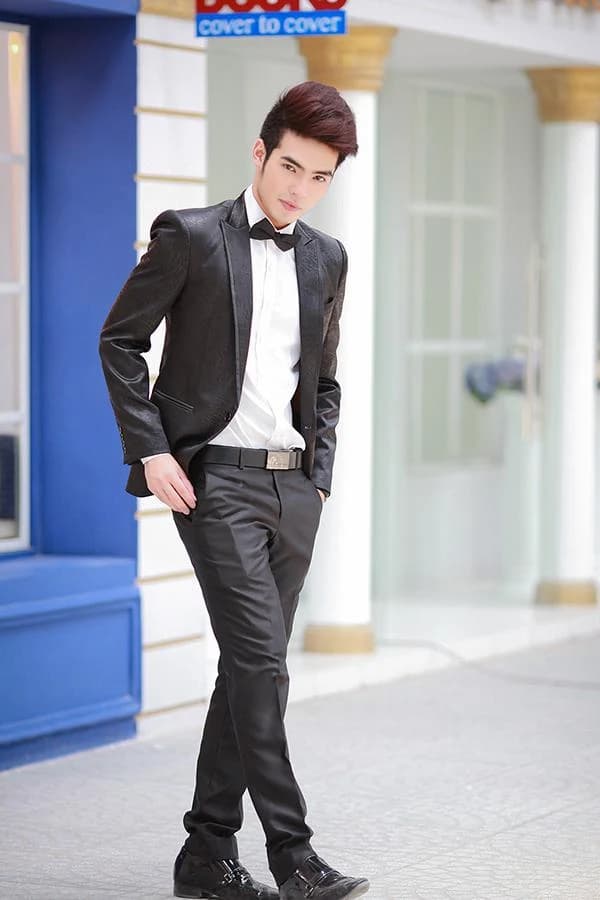
A performance tuxedo is a working tool. A party guest wears it for a few hours and puts it away; a singer or musician wears it under hot lights, singing and moving, night after night. That changes how you choose: movement and durability first, then stage effect.
Reach, bend and turn
Each discipline has its own movements, and the jacket must accommodate them.
- Singers: raise an arm with the microphone, gesture, turn, and sometimes bow deeply. Need a moderately high armhole so the body of the jacket is not dragged and the shoulder is not too tight.
- String players (violin, cello): the left arm reaches far while the right works continuously with the bow. The shoulder and back must be wide enough for the arm to extend without strain. The collar and left shoulder need proper padding, since the instrument rests there.
- Pianists: seated for long periods, arms extended in front of the body. A jacket slightly shorter at the back avoids creasing when seated; pianists often choose a trim tail.
- Wind and percussion players: need a free chest and shoulder to breathe deeply or swing the arms.
- Conductors: the widest arm range of all, often requiring a specially cut sleeve. Many conductors use a tailcoat for formal concerts.
At the fitting, bring your instrument or microphone and perform the real movements. Tell the tailor about your playing posture from the start; it decides the cut. For the tradition of musicians wearing tuxedos, see why orchestral musicians wear tuxedos.
Stretch cloth and breathable lining
Stage lights can push the temperature on the platform very high, and movement adds more, so cloth and lining shape the whole performance.
- Wool with elastane: wool with a little stretch fibre follows movement while holding its crease. Read about it in stretch cloth for tuxedos.
- Tropical-weave wool or mohair-wool blends: breathable, crease resistant, and they drape well under light. Mohair also has a mild sheen.
- Breathable lining: cupro or a half lining reduces the airless feeling across the back. A thick polyester lining runs hot and is better avoided.
- Light to medium weight: a heavy jacket tires the performer quickly.
- Breathable cotton shirts, and the ability to change a shirt between sets if you perspire heavily.
A practical suggestion: if you perform many nights in a row, have at least two shirts, and ideally two jackets to alternate, so each has time to air between nights.
Details that catch the light: metallic and beading
The stage calls for effect, and a performance tuxedo is allowed to stand out more than a party one. But catching light follows rules too.
- Metallic sheen: cloth with lurex or silver thread reflects strongly under spotlights and reads from a distance. Good for a solo singer, less so for a uniformed ensemble. TUX-050 is a black metallic-sheen evening jacket with peak lapels.
- Beading and jacquard: create sparkle in motion. TUX-126 is a red jacquard with copper-gold pattern and beaded lapels. See also beaded stage tuxedos.
- Satin lapels: catch light strongly, good when you want a defined outline, but under strong lamps they burn out easily.
- Colour: black remains the most versatile; on a dark stage navy, wine and cobalt stand out more.
The rule is one light-catching element is enough. With a metallic jacket keep the accessories dark; with a plain jacket you may add a bow tie or pocket square with some lustre. Too many details turn into visual noise on camera.
Durability across many nights
A performance tuxedo suffers more wear than a party one: perspiration, friction from instruments, frequent cleaning.
- Load-bearing seams: the tailor reinforces the armhole and the crotch, where movement puts strain. Double stitching where necessary.
- Buttons: sewn firmly, with spares on hand.
- Lapels and lining: perspiration damages lining fast. A lining can be replaced when needed; ask the tailor about that.
- Care: avoid dry cleaning too often since it wears the cloth; steam and hang to air after each night. Ask the tailor about care for metallic and beaded cloths.
- A second suit: if you perform many nights, two suits worn in rotation help both last.
- Travel bag: a hanging garment bag, not folded, to prevent creases on tour.
When to ask your tailor
Ask before choosing the cloth if you are a professional singer or musician, or if your show involves special movements. The consultant will ask about your instrument, stage type, lighting and how often you perform so the right material is chosen. See made-to-measure tuxedos and book on the fitting page. Making time depends on the style and fitting schedule, so book early ahead of the performance season.