How to wear it
Tuxedo collar gaping or bunching: the causes
A tuxedo collar should hug the shirt collar and show about a centimetre of it at the back. What causes gaping or bunching, and which faults can be fixed.
Mon Amie · 20/10/2026
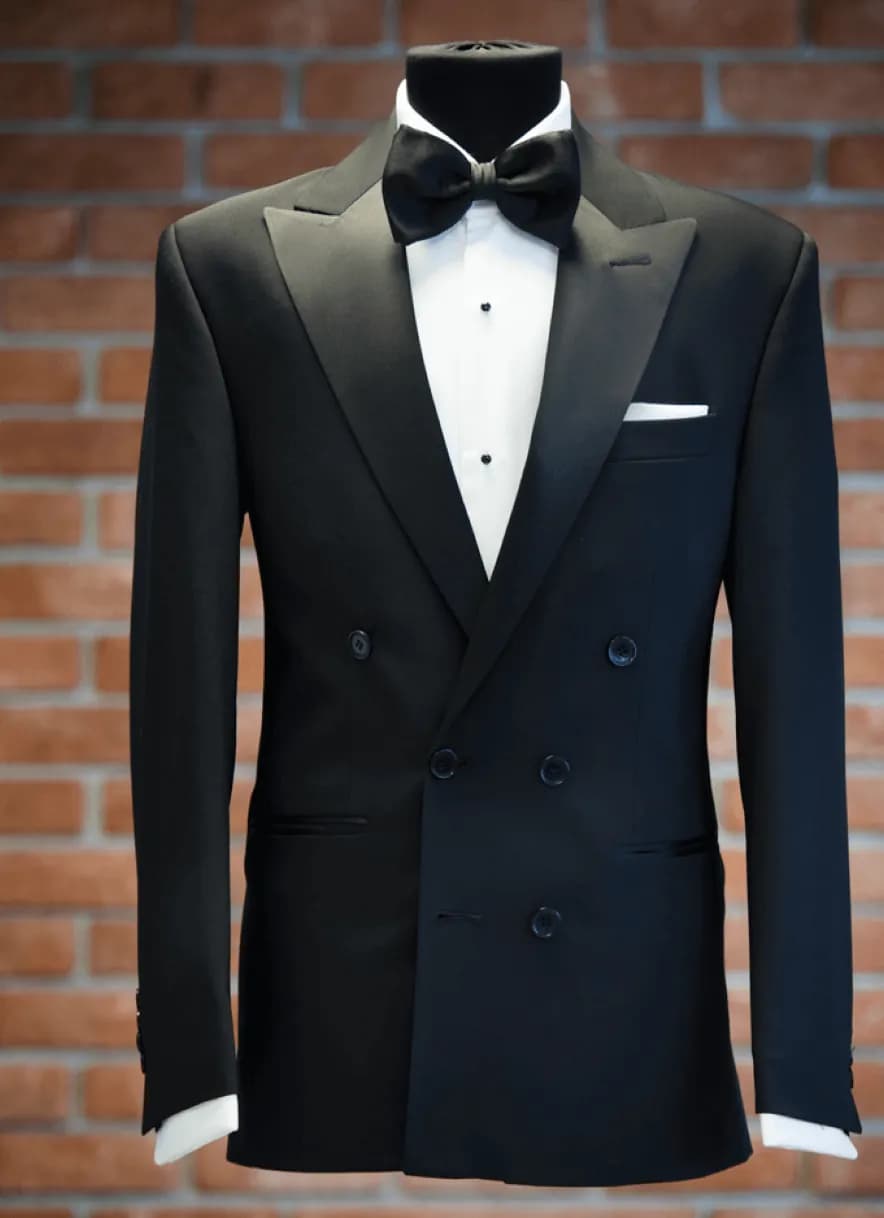
A well-fitted tuxedo collar hugs the shirt collar, lies quietly around the neck and lets about a centimetre of the shirt collar show at the back. If the jacket collar lifts away from the shirt and leaves a gap, or piles into creases beneath the neck, something between your body and the cut is out of line. The cause is rarely in one place, so the fix depends on knowing which kind of problem you have.
What a correct collar looks like
Stand straight and look from behind and from the side. A good collar shows these signs:
- The jacket collar lies against the shirt collar in one continuous line, with no gap between the two layers of cloth.
- At the back, the shirt collar rises about a centimetre above the jacket collar. More showing means the jacket is sliding down; none showing means the jacket collar is riding over it.
- From collar to shoulder, the cloth is flat, with no horizontal waves and no diagonal drag lines.
- When you turn your head or bow slightly, the collar follows and does not slip backward.
On a tuxedo the collar is also where the satin lapel begins. Shawl or peak, the lapel is attached to the collar line, so if the collar lifts, the lapel lifts with it, and the whole chest area is affected.
Gaping versus bunching
Gaping is when the collar stands away from the neck, leaving a gap at the back or at the sides. From the side you can see clear air between shirt collar and jacket collar.
Bunching is when cloth gathers around the base of the collar, forming horizontal folds or overlapping creases right under it, often with the sense that the collar is sitting on top of the shoulders.
The two look alike but are corrected differently, so do not tell the tailor to simply "raise the collar" or "lower the collar" until you know which one you have.
Common causes
Posture. A rounded back, a head carried forward or sloping shoulders pull the back of the jacket differently from an upright person. An arched chest or a hollow back does the same. Posture often decides whether a collar gapes or bunches, which is why a tailor watches you stand naturally before taking any measurement.
Uneven or sloping shoulders. One shoulder higher than the other tips the jacket and drags the collar diagonally. Sloping shoulders in a jacket cut for square shoulders leave extra cloth that gathers at the collar base. See uneven shoulders and a stoop in a tuxedo and what a well-fitting tuxedo shoulder looks like.
A pattern that does not match the body. A ready-made jacket is drafted for an average build. If your back length, shoulder slope or neck size differs, the collar will almost certainly not follow. Even a made-to-measure jacket can be off if your posture was misread at the measuring stage.
The shirt collar. A shirt collar that is too low lets the jacket collar swallow it; one that is too high shows too much and makes the jacket look as if it is sinking. The wing or stand collar of a dress shirt must be considered before the jacket is tried.
A jacket too loose or too tight across the shoulders and chest. A tight chest pulls the collar away from the neck; a loose one lets the whole jacket slide back. Both show at the collar.
How it is worn. Pockets stuffed with a wallet and phone drag the jacket down and make the collar lift. A jacket hung on a poor hanger will also distort over time.
What can be fixed and what cannot
It helps to be realistic before hoping:
- Usually fixable: a mild gap where the collar stand has not been shaped to the neck. A tailor can re-press and reshape the collar, adjust its pitch or take it in at the seam joining collar to body. Mild bunching from gathered cloth can often be released by adjusting the shoulder and neck seams.
- Fixable but involved: when the collar seam must be moved or the shoulder slope reset. This takes work and depends on how much cloth was left in the seams.
- Difficult or not fixable: when the jacket was cut wrongly from the pattern, there is no cloth left to let out, or the whole shoulder construction needs changing. Then rebuilding the upper body, or making a new suit, makes more sense than patching.
So if the tuxedo is for a fixed date, try it early enough to leave time for the tailor to work.
A tip from the Mon Amie workroom
In made-to-measure, the tailor looks at how you stand, measures your shoulder slope and back length, drafts the pattern, and then checks the collar on the baste fitting. If you already own a jacket that gapes or bunches, bring it in so the tailor can see it on you. The process is described under made-to-measure tuxedos, and you can book at the Mon Amie showroom.