By body shape
Tuxedos for Narrow or Sloping Shoulders: Light Pad, Upturned Peak
Narrow or sloping shoulders need a light pad, upturned peak lapels, a straight shoulder line and a pattern adjusted to your real slope.
Mon Amie · 23/10/2026
Sloping shoulders means the line from neck to shoulder point falls more steeply than average; narrow shoulders means the width across is small for the torso. The two often go together, and both show clearly on a dress jacket, because a tuxedo relies on a clean shoulder line as its foundation. The good news is that a made-to-measure tailor has the tools to deal with it, in three places: pad, lapel and pattern.
A light pad
A sloping shoulder in a jacket with a flat shoulder will sag at the shoulder point, because the slope of the bone is steeper than the slope of the pattern. The tailor corrects it with a pad: a thin, wedge-shaped layer, thicker toward the outside, filling the drop so the jacket's shoulder line sits level.
The pad must stay light, though. A thick pad used to build shoulder on a narrow frame reads as another man's jacket, with the shoulder point sticking out past the arm. The aim is to fill the slope, not to widen the shoulder.
Peak lapels pointing upward
A peak lapel has two points aimed up toward the shoulder. That direction pulls the eye outward and upward, making the shoulder line look straighter and wider. A rounded shawl or a notch lapel runs in a curve or across, and supports a narrow shoulder less.
Keep the lapel at a moderate width. A very wide lapel on a narrow shoulder swallows it; a very narrow one makes the shoulder look smaller still. Both should be tried on the body.
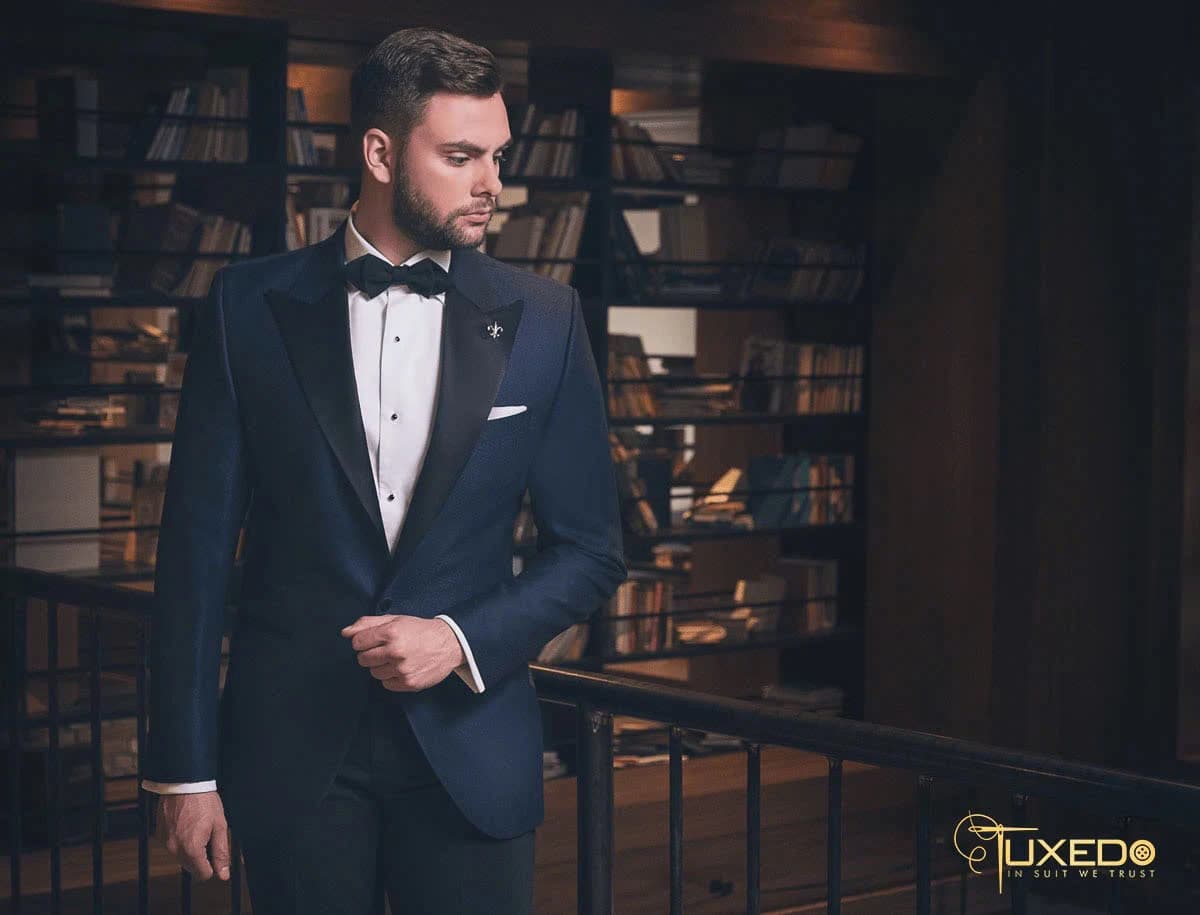
Two real models with peak lapels: TUX-002 is a navy tuxedo with black satin peak lapels, and TUX-060 is a classic black tuxedo with black satin peak lapels. The article on the classic black peak-lapel tuxedo says more about this lapel.
A straight shoulder line
For a sloping shoulder the shoulder seam should run straight, clean and stop exactly at the shoulder point. If the line curves down with the slope, the shoulder looks even more sloped. A straight line that ends at the bone makes a firm frame for the jacket.
It is also wise to avoid a completely soft shoulder with no pad: nothing holds the cloth up, so the shoulder point collapses along the slope of the bone and the lapel loses its support.
See what makes a tuxedo shoulder fit well for a way to check the shoulder point in the mirror.
Adjusting the pattern
This is where made to measure differs from off the peg. Ready-made jackets carry a fixed shoulder slope, usually average. When your shoulders slope more, spare cloth gathers under the collar, the sleeve head juts out, and creases run diagonally from neck to shoulder. Altering a finished jacket for this usually fixes only part of it, because the shoulder and collar both have to be taken apart.
In made to measure, the tailor:
- Measures your true slope and shoulder width.
- Redraws the shoulder line in the pattern to that slope.
- Chooses a pad thick enough to fill the difference and no more.
- Checks at the first trial and adjusts shoulder and collar together.
A tailor will usually watch how you stand naturally before measuring, so stand relaxed and do not push your chest out.
Small points
- The shirt beneath should fit at the shoulder; a shirt too wide across the shoulder makes the slope look worse.
- A flat white pocket square gives the chest more body and reduces the narrow look.
- Avoid a wide double-breasted jacket if the shoulders are very narrow, because the broad front overwhelms them.
- The sleeve head should not overshoot the shoulder point, or the shoulder looks as though it has slipped.
Booking a fitting at Mon Amie
Bring the shirt you plan to wear and let the adviser measure your shoulder in your natural stance. The process is described on the made-to-measure tuxedo page, and you can book a fitting in advance so there is time to work on the shoulder pattern.