Comparisons
Tuxedo vs morning coat: evening dress and day dress
The morning coat has curved tails and striped trousers for daytime; the tuxedo is for evening only. Why daytime weddings use morning dress, and what to wear.
Mon Amie · 17/10/2026
The morning coat is daytime formal wear: a coat whose front curves away into long tails behind, worn with striped trousers, a waistcoat and a long tie. The tuxedo is evening formal wear: a short jacket, satin lapels and a black bow tie. The two are not interchangeable, because tradition sorts formal clothes by the time of day. What truly separates them is the hour, not just the cut.
What a morning coat looks like
The morning coat is single-breasted, with the front cut away in a curve from a single button at the waist and sweeping back into two long tails reaching nearly to the back of the knee. Unlike the tailcoat, its front is curved rather than cut straight across. The lapel is peaked, the cloth is wool, and the colour is charcoal or black.
The complete daytime outfit, known as morning dress, consists of:
- Striped trousers: grey and soft black stripes (often called cashmere stripe), high-waisted.
- Waistcoat: pale grey, buff or in the coat's own cloth, single-breasted.
- White shirt with a turndown or wing collar and cufflinks.
- Silk tie in silver, grey or a pale shade, not a bow tie.
- Black lace-up Oxfords.
- A top hat depending on the event, for example at the races.
The tuxedo belongs to the evening
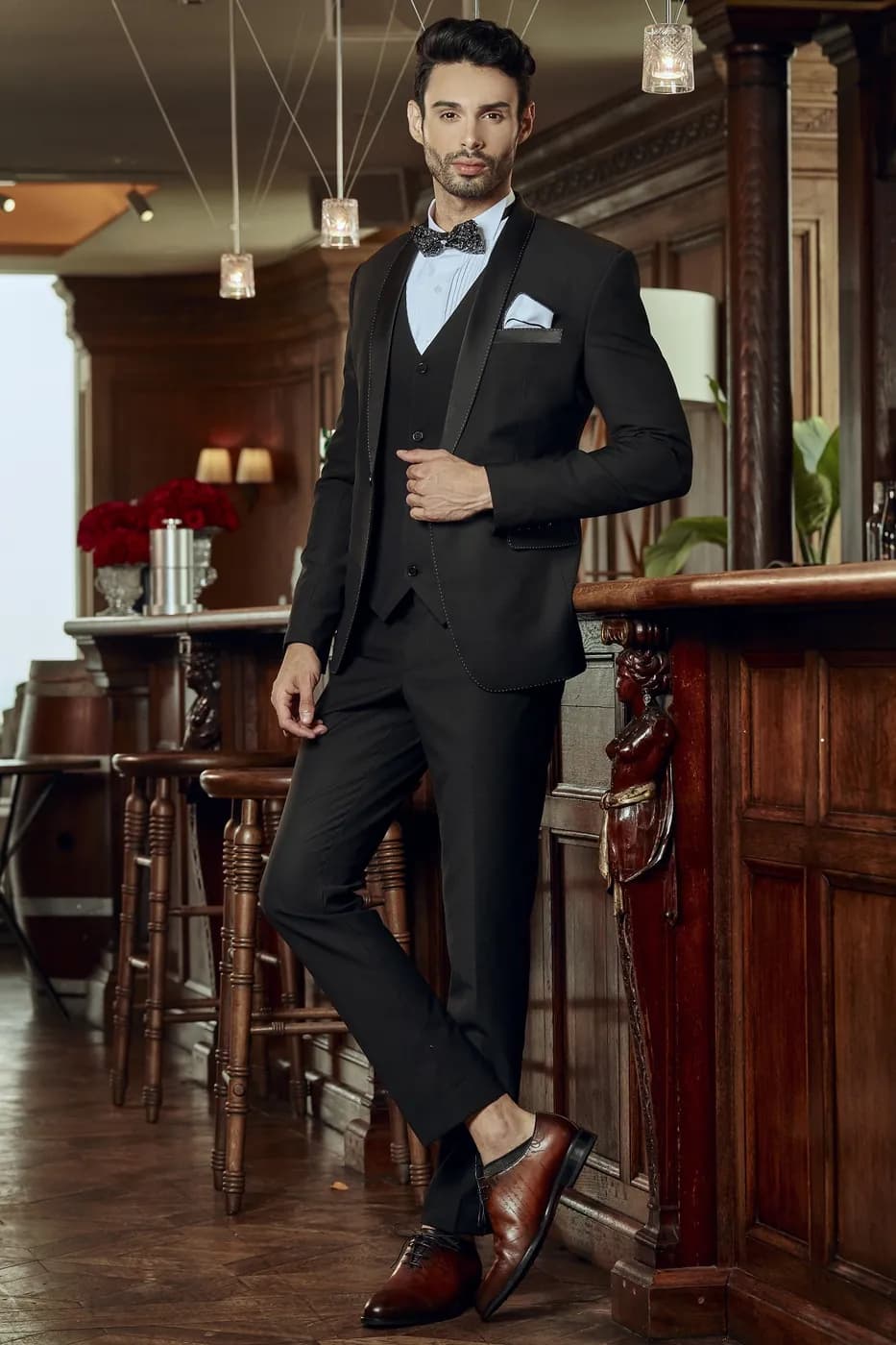
The tuxedo is for the evening: a short tailless jacket, satin-faced lapels, trousers with a satin braid, a white shirt, a black bow tie and patent shoes. Classic convention says not to wear a tuxedo before about six in the evening. The reasons and the exceptions are set out in why the tuxedo is worn after six. Daylight exposes the sheen of satin and makes it look showy, whereas evening light softens it and makes it look richer.
Side by side
| Feature | Morning coat | Tuxedo |
|---|---|---|
| Time | Daytime | Evening |
| Coat | Curved front, long tails | Short, tailless |
| Lapel cloth | Same as the coat | Satin or grosgrain faced |
| Trousers | Striped | Satin braid, same cloth as jacket |
| Waistcoat | Pale grey or buff | Black, or a cummerbund |
| Neckwear | Silk tie | Black bow tie |
| Shoes | Black Oxfords | Patent or opera pumps |
| Occasion | Daytime wedding, racing, daytime ceremony | Evening party, black tie |
Why daytime weddings in Europe call for morning dress
In Britain and some other European countries there was a period when weddings could only be held from the morning until early afternoon; under the older law in England the hours allowed for the ceremony were limited. So the groom and male guests wore daytime formal clothes. Morning dress became the standard for formal weddings and is still worn at traditional ceremonies, as well as at events such as Royal Ascot.
Evening weddings are now common, so the tuxedo or white tie appears more often when the party starts late. For choosing between them, see a morning wedding and an evening reception.
An equivalent in Vietnam
In Vietnam morning dress is very rare, and invitations seldom ask for it. If you attend a formal daytime wedding, there are a few equivalents:
- A three-piece suit in charcoal or navy, with waistcoat, silk tie and white shirt. This is the sensible daytime stand-in for morning dress.
- The ao dai and khan dong for the groom, authentically Vietnamese, especially for the morning procession.
- In the evening of the same day, switch to a tuxedo for the reception.
The point to remember: a sharp suit by day, the tuxedo only at night. If you must wear both in one wedding day, you can have a suit and a tuxedo made, or choose a rental tuxedo for the reception. The wedding tuxedo page has more ideas, and the dress code page sets out the levels.
When to ask a tailor
If the invitation says morning dress, or you are unsure what a formal daytime wedding requires, ask early so there is time to prepare. Book a visit at Mon Amie and bring the invitation or details of the ceremony; an adviser will help you choose.